Volkswagen Virtus review
What 12 independent road tests agree on, and what our own figures say about its price, variants, rivals and safety.
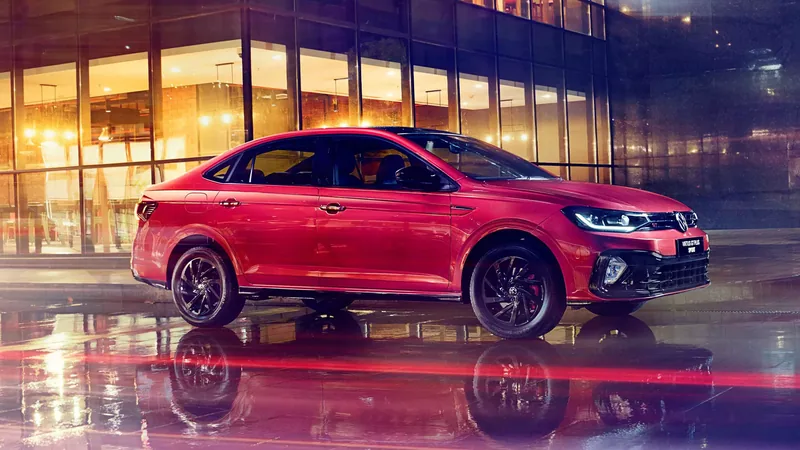
The Virtus in short
Reviewers agree the Virtus is superbly stable at highway speeds, handles well, rides bad roads comfortably if on the firm side, has a strong 1.5 with a quick DSG, a smooth 1.0 automatic, supportive front seats, a big boot and a good view out. The trade-offs are hard cabin plastics, a back seat best for two, a 1.0 that is soft low down and coarse near the redline, a DSG that can be jerky in slow traffic, light steering and fiddly touch climate controls.
It costs ₹10,70,900 to ₹19,19,900 ex-showroom across 11 variants and 3 engine-and-gearbox choices. On our valuation the best-covered upgrade is Highline → Highline Plus (Petrol automatic): 282% of the price rise returned in equipment.
By the CarMaths team. The verdict’s first sentence summarises the road tests below; the rest is our own data.
Strengths
- Superb at highway speeds
- Confident handling
- Absorbent ride
- Strong 1.5 with a quick DSG
- Smooth 1.0 automatic
- Supportive front seats
- Big boot
- 3 engine-and-gearbox choices
- The Highline → Highline Plus upgrade (Petrol automatic) returns 282% of its price in equipment
Weaknesses
- DSG jerky in slow traffic
- Hard cabin plastics
- Back seat best for two
- The GT Plus → GT Plus Sport upgrade (Petrol DSG) returns only 0% of its price in equipment
How the Virtus drives, from 12 road tests
We read 10 written road tests and 2 video reviews by Indian motoring publications and channels on 16 November 2026. A point is listed only where at least three of them agree, and it is written in our own words. Equipment is not taken from reviews: what each variant has comes from Volkswagen’s own documents. Volkswagen's own brochure still lists the same engines and gearboxes as at launch in 2022, including the 6-speed automatic on the 1.0, so reviews since 2022 count. Most come from the maker's launch drive in May 2022; later ones include comparison tests and a 15-month, 12,000 km long-term test of the 1.5 DSG. No long-term test covered the 1.0 automatic.
- Highway stabilityStrength
- Eight reviews found it superbly stable and relaxed at highway speeds.
- HandlingStrength
- Eight reviews found the handling confident and composed; five noted some body roll.
- Ride comfortStrength
- Nine reviews found the ride comfortable and absorbent over bad roads; five found it on the firm side, and four felt big potholes and sharp bumps come through.
- SteeringMixed
- Five reviews found the steering light and wanting more weight at speed. Four found it precise and communicative.
- 1.5 and DSGStrength
- Ten reviews found the 1.5 turbo strong, and nine found the DSG smooth and quick on the open road. Six found the DSG jerky or hesitant at low speed in traffic, including the long-term test.
- 1.0 engineMixed
- Seven reviews found the 1.0 turbo eager and lively once on boost. Six found it soft below about 2,000 rpm, and six found it coarse or noisy near the redline.
- 1.0 automaticStrength
- Seven reviews found the 1.0's 6-speed automatic well suited to it, responsive and easy in town, three noting smooth shifts. Two found it pauses before a quick downshift.
- 1.0 manualStrength
- Three reviews found the 1.0 manual's clutch light and its shift easy; one found the shift lacks feel.
- Cabin qualityWeakness
- Eight reviews found hard plastics with little soft-touch material; four found it below the Honda City or older Volkswagens. Two praised the build.
- Front seatsStrength
- Seven reviews found the front seats large, comfortable and supportive.
- Rear seatMixed
- Seven reviews found the back seat best for two adults; four found less knee room than in some rivals. Two found room for three.
- BootStrength
- Six reviews found the boot large and practical.
- Climate controlsWeakness
- Three reviews found the touch climate controls fiddly to use on the move.
- VisibilityStrength
- Five reviews found the view out good.
- BrakesStrength
- Three reviews found the brakes strong and progressive.
Every Virtus engine and gearbox
| Powertrain | Output | Certified | Price |
|---|---|---|---|
| Petrol manual5 variants | 113 bhp, 178 Nm | 20.19 kmpl | ₹10.71 L – ₹15.16 L |
| Petrol automatic4 variants | 113 bhp, 178 Nm | 18.7 kmpl | ₹14.71 L – ₹16.35 L |
| Petrol DSG2 variants | 148 bhp, 250 Nm | 19.62 kmpl | ₹18.85 L – ₹19.20 L |
*Ex-showroom, Delhi · Prices checked Nov 2026
Which Virtus powertrain to choose, and what each costs over the other
Which Virtus upgrade is worth it
- Best coveredHighline → Highline Plus₹29,000 more buys ₹82,000 of equipment we value, 282%Worth it
- Least coveredGT Plus → GT Plus Sport₹35,000 more buys ₹0 of equipment we value, 0%Pricey
Safety
Global NCAP: 5 stars for adult occupants and 5 for children. What safety equipment each variant carries is on the Virtus page.
The Virtus against its rivals on price
| Car | From | To | Variants |
|---|---|---|---|
| Skoda Slavia | ₹9,99,900 | ₹18,84,000 | 12 |
| Volkswagen Virtus | ₹10,70,900 | ₹19,19,900 | 11 |
| Hyundai Verna | ₹10,99,200 | ₹18,31,200 | 12 |
| Honda City | ₹11,99,900 | ₹21,35,800 | 8 |
Ex-showroom, Delhi, the variants we hold. Rivals are the cars we match the Virtus against on price.
Virtus key figures
- Certified efficiency
- 20.19 kmpl
- Engine
- 999 cc
- Power
- 113 bhp
- Torque
- 178 Nm
- Seats
- 5
- Length
- 4,561 mm
- Wheelbase
- 2,651 mm
- Ground clearance
- 179 mm
- Boot
- 521 litres
- Warranty
- 4 years / 1,00,000 km
From Volkswagen’s own documents; figures shown are the Comfortline’s where variants differ. Full Virtus details
What the Virtus costs on the road
The Comfortline, the cheapest Virtus, is ₹12,51,272 on the road in Delhi, with an EMI from ₹20,658 a month (20% down, 8.75% for 5 years). Across the 36 states and union territories whose tax we verify, the same car runs from ₹11,66,955 in Dadra and Nagar Haveli and Daman and Diu to ₹13,43,261 in Karnataka.
How the Virtus compares with its rivals
Common questions
- Is the Volkswagen Virtus worth buying?
- Reviewers agree the Virtus is superbly stable at highway speeds, handles well, rides bad roads comfortably if on the firm side, has a strong 1.5 with a quick DSG, a smooth 1.0 automatic, supportive front seats, a big boot and a good view out. The trade-offs are hard cabin plastics, a back seat best for two, a 1.0 that is soft low down and coarse near the redline, a DSG that can be jerky in slow traffic, light steering and fiddly touch climate controls. It costs ₹10,70,900 to ₹19,19,900 ex-showroom across 11 variants.
- Which Volkswagen Virtus variant is the best value?
- On our valuation, the upgrade whose price is best covered by the equipment it adds is Highline to Highline Plus (Petrol automatic): ₹29,000 more for 282% of that in equipment. The least covered is GT Plus to GT Plus Sport at 0%.
- Is the Volkswagen Virtus comfortable to drive?
- Nine reviews found the ride comfortable and absorbent over bad roads; five found it on the firm side, and four felt big potholes and sharp bumps come through.