Cars With Rear Ventilated Seats in India
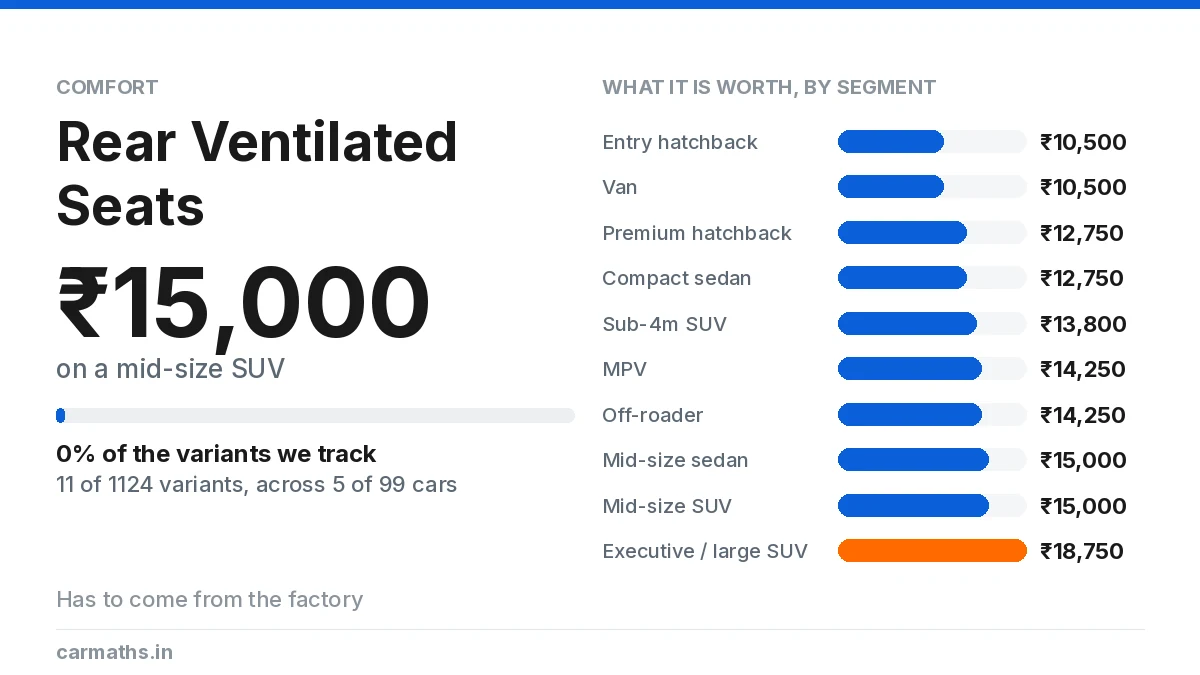
We value Rear Ventilated Seats at ₹15,000 on a mid-size SUV, and ₹10,500 to ₹18,750 depending on the segment. 11 of the 1122 variants we track carry them, across 5 of 99 models — the cheapest being the Kia Syros HTX(O) (Petrol DCT) at ₹14,99,900.
*Ex-showroom, Delhi · Prices checked Oct 2026
What are rear ventilated seats?
Rear ventilated seats have fans inside the rear seat cushion and backrest that move air through perforated upholstery, the same idea as ventilated front seats. They are rare, found on a handful of the most expensive variants.
How they work
Fans built into the seat move cabin air through tiny holes in perforated upholstery, usually leatherette. The controls are often on the rear armrest or at the back of the centre console. Like the front seats, they cool you by moving air, not by chilling it.
Who it is for
It matters most if the car is often chauffeur-driven, or if family members spend long hot journeys in the back. Rear AC vents cool the rear cabin; ventilated seats deal with the heat trapped where your back meets the seat.
Cushion, backrest or both
As with front seats, the air may come through the seat cushion alone or through the cushion and the backrest. Your back is where you feel the heat most on a long drive, so it is worth checking which you get.
Which row
In a seven-seater, ventilation goes to the middle row, usually the two outer seats or a pair of captain's chairs. The third row does not get it. Where a car is sold as both a six-seater and a seven-seater, check which version has it; we model the seven-seater.
Worth it in Indian summers?
On a long afternoon drive the rear AC vents cool the air, but the back of a leatherette seat still traps heat. Rear ventilation fixes that for the people behind you. It is most worth having if the car is chauffeur-driven or the family often travels long distances in the heat; for short city trips the rear AC vents do most of the work.
How common it is, by fuel
Share of the variants we track that carry Rear Ventilated Seats.
- Electric 3% (4 of 103)
- Diesel 1% (3 of 225)
- Petrol <1% (4 of 659)
- CNG 0% (0 of 112)
- Strong hybrid 0% (0 of 23)
Of the 294 variants we track with Front Ventilated Seats, 11 also have Rear Ventilated Seats. Rear ventilation is an addition to the front pair rather than an alternative to it.
How we decide a variant has it
We credit it where the manufacturer lists ventilation for the rear seats on that variant. It is priced below the front pair, which matter more to the person who drives the car every day.
What to check at the showroom
- Sit in the back, switch them on and feel for air on the cushion and the backrest.
- Find where the rear passengers control them.
- Check whether both outer rear seats have them.
Written by Rupesh Kumar · explanation reviewed
Standard, extra, or left out
0 cars have ventilated rear seats on every version. On 5 cars it comes only on some versions, so you pay to climb to it. 94 cars do not offer them on any version.
| Car | First version with it | Over the base trim |
|---|---|---|
| Honda Elevate | ZX+ · 2 of 9 versions | +₹5,00,000 |
| Kia Syros EV | HTX+ · 2 of 7 versions | +₹6,00,000 |
| Kia Syros | HTX(O) · 2 of 17 versions | +₹6,58,000 |
| Mahindra XEV 9S | Three · 2 of 6 versions | +₹7,20,000 |
| Mahindra XUV 7XO | AX7L · 3 of 20 versions | +₹9,41,499 |
The valuation
₹15,000Fans in the rear seat cushions, as the front ventilated seats have.
Why this number: Perforated upholstery and fans built into the rear seat base. Priced below the front pair, which matter more to the person who drives the car every day.
No purchasable equivalent — an estimate of worth, not of cost. Low confidence means the figure is our judgement, not a shop price — which is why the upgrades below show what manufacturers actually charge for it: that is the check on our number. This is what the feature is worth to a buyer who wants it — not what it costs a manufacturer to fit, which nobody outside the factory knows and which would not help you anyway. How we arrive at every figure.
What it is worth on each kind of car
The same feature is worth less on a cheaper car: the buyer is more price-sensitive and it is a larger share of what they are paying.
10 variant upgrades on this site add it
Every one of them bundles it with other equipment, so none of these price differences is the price of this feature on its own. The upgrades that change the least besides it are listed first — they are the ones that tell you most.
| The upgrade | It costs | We value this at | Also changes | Verdict |
|---|---|---|---|---|
| XUV 7XO AX7T → AX7L Mahindra · Petrol automatic | ₹1,53,000 | ₹18,750 | 2 other items | Pricey |
| XUV 7XO AX7T → AX7L Mahindra · Diesel manual | ₹1,61,499 | ₹18,750 | 2 other items | Pricey |
| XUV 7XO AX7T → AX7L Mahindra · Diesel automatic | ₹1,71,000 | ₹18,750 | 2 other items | Pricey |
| Elevate ZX → ZX+ Honda · Petrol manual | ₹1,41,000 | ₹15,000 | 4 other items | Fair upgrade |
| Elevate ZX → ZX+ Honda · Petrol CVT | ₹1,41,000 | ₹15,000 | 4 other items | Fair upgrade |
| Syros HTX → HTX(O) Kia · Petrol DCT | ₹98,000 | ₹13,800 | 6 other items | Pricey |
| Syros HTX → HTX(O) Kia · Diesel automatic | ₹1,00,000 | ₹13,800 | 6 other items | Pricey |
| XEV 9S Two Above → Three Mahindra · Electric 79 kWh | ₹1,90,000 | ₹18,750 | 6 other items | Pricey |
| Syros EV HTX → HTX+ Kia · Electric 51.4 kWh | ₹1,50,000 | ₹13,800 | 9 other items | Fair upgrade |
| Syros EV HTK+ → X-Line Kia · Electric 51.4 kWh | ₹3,00,000 | ₹13,800 | 19 other items | Fair upgrade |
The cheapest variant of each car that has it
The last column is what that variant costs over the car's own entry price. It is not the price of this feature — climbing to that trim buys everything else on the way up too. It is the honest answer to “what do I have to spend on this car to get one?”
| Car | Cheapest variant with it | Ex-showroom | Over the base trim | Variants |
|---|---|---|---|---|
| Kia Syros | HTX(O) Petrol DCT | ₹14,99,900 | +₹6,58,000 | 2 of 17 |
| Honda Elevate | ZX+ Petrol manual | ₹16,80,000 | +₹5,00,000 | 2 of 9 |
| Kia Syros EV | HTX+ Electric 51.4 kWh | ₹19,49,900 | +₹6,00,000 | 2 of 7 |
| Mahindra XUV 7XO | AX7L Diesel manual | ₹23,40,499 | +₹9,41,499 | 3 of 20 |
| Mahindra XEV 9S | Three Electric 79 kWh | ₹27,85,000 | +₹7,20,000 | 2 of 6 |
Ex-showroom, Delhi. How we read each car's prices and equipment, and how often we re-check them: where the numbers come from.
Common questions
- What are rear ventilated seats?
- Rear ventilated seats have fans inside the rear seat cushion and backrest that move air through perforated upholstery, the same idea as ventilated front seats. They are rare, found on a handful of the most expensive variants.
- Are rear ventilated seats worth it?
- Mainly if someone regularly travels in the back for long journeys in the heat, or the car is chauffeur-driven. The driver gains nothing from them, so on a self-driven car front ventilated seats matter more.
- Do ventilated rear seats cool the air?
- No. Fans move cabin air through the perforated seat, which takes away the heat and sweat where your body meets it. The air is only as cool as the cabin, so the AC still matters.
- Do seven-seaters have ventilated third-row seats?
- Not among the cars we track. Where a seven-seater has rear ventilation, it is on the middle row.
- Can rear passengers control the ventilated seats?
- Usually yes, with buttons on the rear armrest, the back of the centre console or a rear screen. On some cars the driver or front passenger controls them from the front. Check on the test drive.
- What are ventilated rear seats worth in a car?
- CarMaths values it at ₹15,000 on a mid-size SUV, scaling to ₹10,500 on the cheapest segment and ₹18,750 on the most expensive. Perforated upholstery and fans built into the rear seat base. Priced below the front pair, which matter more to the person who drives the car every day.
- Can ventilated rear seats be added after you buy the car?
- No. They have to come from the factory, so the trim that has them is the only way to get them. That is why the figure is what the feature is worth to you rather than what it costs to fit.
- Which is the cheapest car with ventilated rear seats?
- Of the 99 cars CarMaths tracks, the cheapest variant carrying it is the Kia Syros HTX(O) (Petrol DCT) at ₹14,99,900 ex-showroom, which is ₹6,58,000 above that car's entry price.
- What does a variant upgrade that adds ventilated rear seats cost?
- The typical step that adds it costs ₹1,53,000, across 10 such upgrades — but every one of those upgrades adds other equipment too, so that figure is the price of the whole gap, not of this feature.