Maruti Alto K10: which powertrain?
The Maruti Alto K10 is sold as 3 separate ranges. Pick a trim and this shows what each powertrain costs at that trim, and whether the gearbox brings any equipment with it.
Spotted something wrong? Report a correction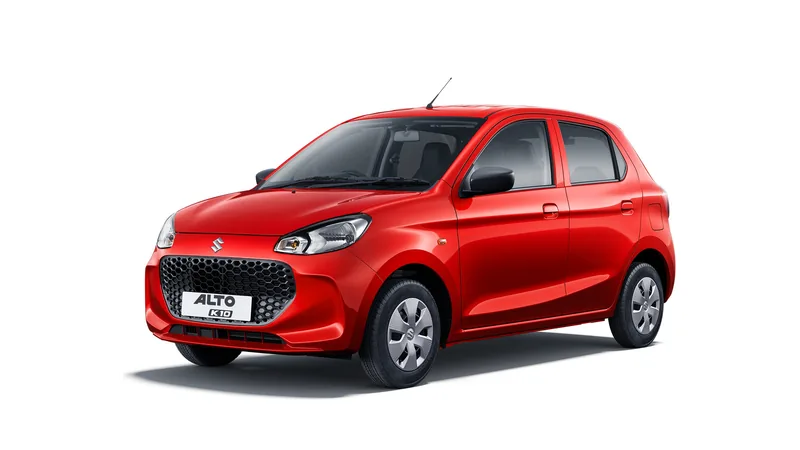
The 3 ranges
Petrol manual
4 trims · ₹3,69,900 to ₹4,99,900
- Engine
- 1.0L K10C Dual Jet Dual VVT
- Power / torque
- 68 bhp / 91 Nm
- Claimed efficiency
- 24.39 kmpl
CNG manual
2 trims · ₹4,84,400 to ₹5,34,400
- Engine
- 1.0L K10C S-CNG
- Power / torque
- 56 bhp / 82 Nm
- Claimed efficiency
- 33.4 km/kg
Petrol AGS
2 trims · ₹4,97,400 to ₹5,44,900
- Engine
- 1.0L K10C Dual Jet Dual VVT
- Power / torque
- 68 bhp / 91 Nm
- Claimed efficiency
- 24.9 kmpl
*Ex-showroom, Delhi · Prices checked Oct 2026
Across every car we track
- AMT vs CVT vs DCT vs Torque Converter: Price Gap in India — what the automatic costs over the manual, car by car.
- What a Factory CNG Kit Actually Costs — what the factory CNG kit costs over petrol.
- CNG Cars in India 2026: Every Model, Price and km/kg — every CNG car, with certified km/kg and the CNG automatics.
Trim by trim
Each block is one trim level. The cheapest powertrain at that trim is the baseline; every other is shown as what it costs over it.
- Trim
Maruti Alto K10 LXi(O)
Powertrain Ex-showroom Vs cheapest Efficiency Equipment change Petrol manual68 bhp / 91 Nm ₹3,99,900 — 24.39 kmpl Baseline CNG manual56 bhp / 82 Nm ₹4,84,400 +₹84,500 33.4 km/kg None — the difference is powertrain only - Trim
Maruti Alto K10 VXi(O)
Powertrain Ex-showroom Vs cheapest Efficiency Equipment change Petrol manual68 bhp / 91 Nm ₹4,52,400 — 24.39 kmpl Baseline Petrol AGS68 bhp / 91 Nm ₹4,97,400 +₹45,000 24.9 kmpl None — the difference is powertrain only CNG manual56 bhp / 82 Nm ₹5,34,400 +₹82,000 33.4 km/kg None — the difference is powertrain only - Trim
Maruti Alto K10 VXi+(O)
Powertrain Ex-showroom Vs cheapest Efficiency Equipment change Petrol manual68 bhp / 91 Nm ₹4,99,900 — 24.39 kmpl Baseline Petrol AGS68 bhp / 91 Nm ₹5,44,900 +₹45,000 24.9 kmpl None — the difference is powertrain only
Maruti Alto K10 powertrains: common questions
- How many powertrains is the Maruti Alto K10 sold with?
- 3: Petrol manual, CNG manual, Petrol AGS. The cheapest way into the range is the STD(O) 1.0 Petrol MT at ₹3,69,900 ex-showroom, and the dearest entry point is the VXi(O) 1.0 Petrol AGS at ₹4,97,400.
- On the Maruti Alto K10, does changing powertrain change the equipment?
- Not on the LXi(O), which is sold as both the LXi(O) 1.0 Petrol MT and the LXi(O) 1.0 CNG MT with identical equipment. The ₹84,500 between them buys the powertrain and nothing else.
- What mileage does each Maruti Alto K10 powertrain claim?
- Petrol manual: 24.39 kmpl; CNG manual: 33.4 km/kg; Petrol AGS: 24.9 kmpl. These are the manufacturer's certified figures, not our own, and CNG is certified per kilogram rather than per litre — the two numbers are not comparable directly.
- Does CarMaths say when the Maruti Alto K10's CNG pays for itself?
- Not yet. That answer needs a CNG price we can stand behind in your city, and the CNG figures available to us fail their own consistency check — they swing by twelve rupees between two cities in one state, and in one city they read above petrol. This page gives the price gap and the certified efficiency and leaves the division to you, rather than printing a payback distance that would be wrong.
We do not tell you when CNG pays for itself
The useful answer is a distance — drive this far and the cheaper fuel has repaid the premium. For diesel against petrol we do work it out, in the panel above: it holds this state's pump prices, and where we have a certified efficiency for both sides of the same trim it gives you the premium, the yearly saving and the kilometres at which one repays the other. Change any figure to your own.
CNG is the one we withhold, and it is a sourcing problem rather than an arithmetic one: the CNG prices we could find do not survive their own consistency check — they swing by twelve rupees between two cities in one state, and in one city they read above petrol. A payback distance built on those would be a wrong answer rather than a missing one.
Where a row above reads “—”, the manufacturer publishes no certified efficiency for that powertrain and we store none rather than borrow another's. Type the figure you actually get and the arithmetic follows it.
Everything on this page is the same arithmetic used everywhere else on this site: equipment priced in rupees, against the price difference. What it cannot price is the powertrain itself — a gearbox, a fuel system, running cost, resale or refuelling convenience.
What this car's data leaves out
Nothing is left out beyond the dual-tone and appearance editions this site excludes everywhere.
Data notes — where these figures come from
The 1.0 K10C petrol in manual and AGS and the S-CNG manual, across all four grades Maruti prices — every one now carrying the "(O)" suffix, which is simply how the range is sold. This is a sparse car and the feature list reflects that honestly. Under-credited deliberately, because the brochure names something narrower than our registry prices: the ORVMs are internally adjustable rather than electrically adjustable; the power windows are front-only, so the rear-window feature is not credited; the air conditioner is manual, not automatic; ESP is listed on every variant, which earns the stability-control entry now that it no longer requires hill-start assist (29 Oct 2026); and there is no day/night mirror or rear defogger row at all. The VXi (O) has central door locking but the remote keyless entry arrives only at VXi+ (O), so the locking feature starts there. One consequence is worth stating plainly: the step from STD (O) to LXi (O) scores zero, because what ₹30,000 buys there is air conditioning and power steering, and our registry prices neither. Both are standard on every other car we cover, so they have never needed a valuation; on the cheapest car in India they are a real upgrade. The zero is a gap in our coverage, not a verdict on the car — read it as "we cannot price this step" rather than "this step buys nothing".