Maruti Eeco: which powertrain?
The Maruti Eeco is sold as 2 separate ranges. Pick a trim and this shows what each powertrain costs at that trim, and whether the gearbox brings any equipment with it.
Spotted something wrong? Report a correction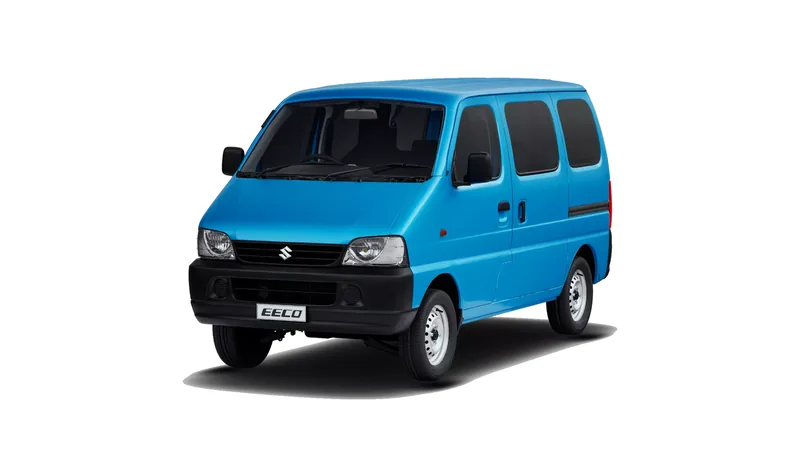
The 2 ranges
Petrol manual
2 trims · ₹5,28,400 to ₹5,61,300
- Engine
- 1.2L K12N Petrol
- Power / torque
- 81 bhp / 106 Nm
- Claimed efficiency
- 19.71 kmpl
CNG manual
1 trim · ₹6,45,800
- Engine
- 1.2L K12N CNG
- Power / torque
- 71 bhp / 95 Nm
- Claimed efficiency
- 26.78 km/kg
*Ex-showroom, Delhi · Prices checked Nov 2026
Across every car we track
- What a Factory CNG Kit Actually Costs — what the factory CNG kit costs over petrol.
- CNG Cars in India 2026: Every Model, Price and km/kg — every CNG car, with certified km/kg and the CNG automatics.
Trim by trim
Each block is one trim level. The cheapest powertrain at that trim is the baseline; every other is shown as what it costs over it.
- Trim
Maruti Eeco 5-Seater AC
Powertrain Ex-showroom Vs cheapest Efficiency Equipment change Petrol manual81 bhp / 106 Nm ₹5,61,300 — 19.71 kmpl Baseline CNG manual71 bhp / 95 Nm ₹6,45,800 +₹84,500 26.78 km/kg None — the difference is powertrain only
Maruti Eeco powertrains: common questions
- How many powertrains is the Maruti Eeco sold with?
- 2: Petrol manual, CNG manual. The cheapest way into the range is the 5-Seater STD 1.2 Petrol MT at ₹5,28,400 ex-showroom, and the dearest entry point is the 5-Seater AC 1.2 CNG MT at ₹6,45,800.
- On the Maruti Eeco, does changing powertrain change the equipment?
- Not on the 5-Seater AC, which is sold as both the 5-Seater AC 1.2 Petrol MT and the 5-Seater AC 1.2 CNG MT with identical equipment. The ₹84,500 between them buys the powertrain and nothing else.
- What mileage does each Maruti Eeco powertrain claim?
- Petrol manual: 19.71 kmpl; CNG manual: 26.78 km/kg. These are the manufacturer's certified figures, not our own, and CNG is certified per kilogram rather than per litre — the two numbers are not comparable directly.
- Does CarMaths say when the Maruti Eeco's CNG pays for itself?
- Not yet. That answer needs a CNG price we can stand behind in your city, and the CNG figures available to us fail their own consistency check — they swing by twelve rupees between two cities in one state, and in one city they read above petrol. This page gives the price gap and the certified efficiency and leaves the division to you, rather than printing a payback distance that would be wrong.
We do not tell you when CNG pays for itself
The useful answer is a distance — drive this far and the cheaper fuel has repaid the premium. For diesel against petrol we do work it out, in the panel above: it holds this state's pump prices, and where we have a certified efficiency for both sides of the same trim it gives you the premium, the yearly saving and the kilometres at which one repays the other. Change any figure to your own.
CNG is the one we withhold, and it is a sourcing problem rather than an arithmetic one: the CNG prices we could find do not survive their own consistency check — they swing by twelve rupees between two cities in one state, and in one city they read above petrol. A payback distance built on those would be a wrong answer rather than a missing one.
Where a row above reads “—”, the manufacturer publishes no certified efficiency for that powertrain and we store none rather than borrow another's. Type the figure you actually get and the arithmetic follows it.
Everything on this page is the same arithmetic used everywhere else on this site: equipment priced in rupees, against the price difference. What it cannot price is the powertrain itself — a gearbox, a fuel system, running cost, resale or refuelling convenience.
What this car's data leaves out
Left out: the six-seater, which changes the seating rather than the equipment, and the commercial Cargo, Tour and Ambulance versions. Every Eeco variant scores the same on the equipment we price, because what separates them — air-conditioning and a cabin filter — is not in our registry.
Data notes — where these figures come from
THE 5 SEATER STANDARD, 5 SEATER AC AND 5 SEATER AC CNG ONLY. Maruti's passenger price list carries a fourth, the 6 Seater Standard at Rs 5,54,900, and it is left out deliberately: it is the Standard with a third-row bench in place of the 5-seater's luggage space, and its price sits between the two 5-seaters, so laddering it in would score a seating layout as equipment and then report the dearer 5 Seater AC as giving up a row of seats - the same error that keeps a gearbox from ever being scored as equipment here. The Ambulance, Ambulance Shell, Cargo and Tour are commercial versions and are not modelled. WHAT THE UPGRADE BUYS IS NOT IN OUR REGISTRY, and that has to be read correctly: the brochure's only differences between the Standard and the AC are the air-conditioner, a cabin air filter and a co-driver seat-back pocket, none of which we value, so the Rs 32,900 step scores zero - the same position as the Alto K10's STD(O) to LXi(O). Read it as 'we cannot price this upgrade', not 'this upgrade buys nothing'. ESP is listed on every variant, which earns the stability-control entry now that it no longer requires hill-start assist (29 Oct 2026); the wheels carry centre caps, not full wheel covers; there is no audio system, no power windows and no central locking on any variant; and the reverse parking sensors are not a registry feature. Six airbags (dual front plus side and curtain) are standard on all three and credited. NO SEGMENT PARTNER: Maruti files the Eeco under 'Vans', separate from its MPVs, and no other van is in the catalogue, so the Eeco has no model-against-model matchup by design - a van matched against an entry hatchback would compare two body styles on equipment alone. The 'van' segment carries the entry-hatchback multiplier, 0.7, because the two are bought at the same money. WIRELESS ANDROID AUTO (9 Oct 2026): not credited on any variant. The Eeco has no touchscreen.