Cars With Head-Up Display in India
We value Head-Up Display at ₹20,000 on a mid-size SUV, and ₹14,000 to ₹25,000 depending on the segment. 46 of the 1122 variants we track carry it, across 14 of 99 models — the cheapest being the Maruti Baleno Alpha (Petrol manual) at ₹9,09,900.
*Ex-showroom, Delhi · Prices checked Oct 2026
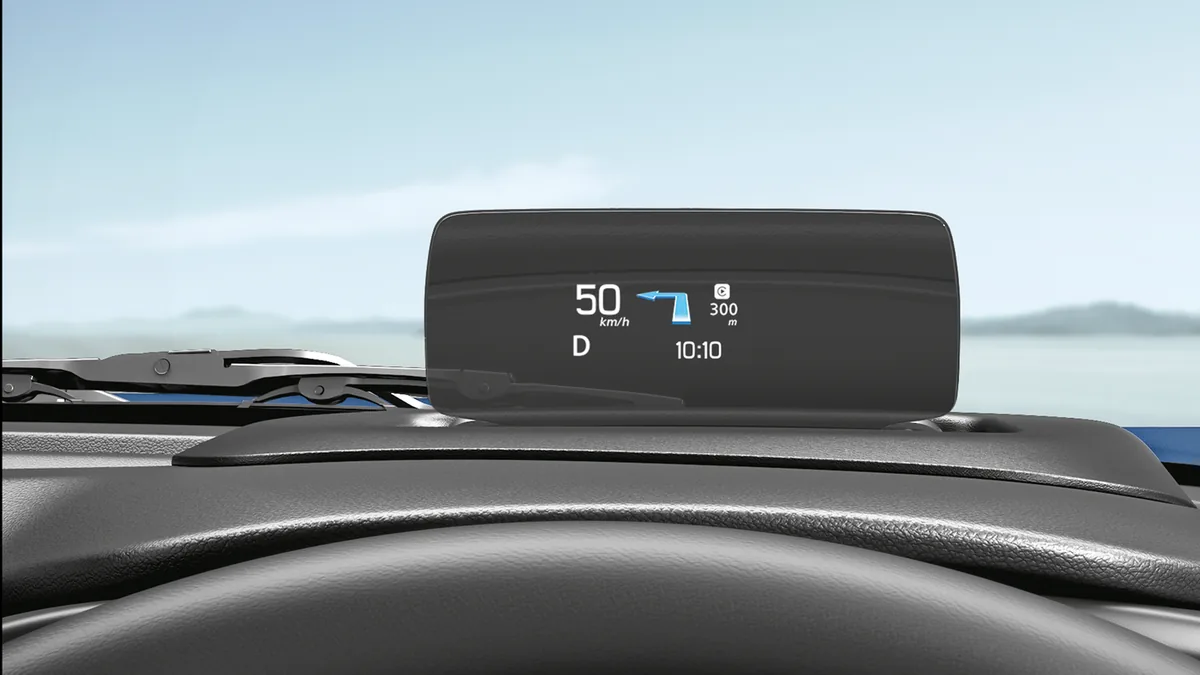
What is a head-up display?
A head-up display (HUD) shows your speed, and often navigation arrows and warnings, as a floating image in your line of sight above the dashboard, so you can read it without looking down at the instrument cluster.
How it works
A small projector in the top of the dashboard throws the image onto either a clear flip-up panel in front of the driver, called a combiner, or a specially treated area of the windscreen. The image appears to float out beyond the bonnet, so your eyes stay focused near the road. You can usually adjust its height and brightness.
What to expect
It is most useful at night and on highways, where looking down to check your speed costs the most attention. Polarised sunglasses can make some head-up displays hard to see, so wear yours on the test drive if you use them.
Combiner or windscreen
A combiner head-up display projects onto a small clear panel that rises from the dashboard; it is cheaper to build and the image sits a little lower in your view. A windscreen display projects onto the glass itself, so the image appears further ahead and larger, but the windscreen needs a special layer, which makes a replacement windscreen dearer. Brochures do not always say which kind a car has, so look at it in the showroom.
What it shows
Every head-up display shows your speed. Many add turn-by-turn arrows from the car's own navigation, the gear, cruise-control status and warnings from the driver-assistance systems. Directions from Android Auto or Apple CarPlay often do not reach the head-up display, so if you navigate with your phone, check whether its arrows appear there.
How common it is, by fuel
Share of the variants we track that carry Head-Up Display.
- Strong hybrid 26% (6 of 23)
- Electric 4% (5 of 103)
- Petrol 4% (30 of 659)
- Diesel 2% (5 of 225)
- CNG 0% (0 of 112)
Where it depends on the version, not just the trim
On these cars, a trim carries it with one gearbox, fuel or battery and not another.
How we decide a variant has it
We credit it where the manufacturer lists a head-up display on that variant, whether it uses a combiner panel or the windscreen. A stick-on unit that mirrors your phone is not the same thing and does not count.
What to check at the showroom
- Sit in your driving position, adjust its height and check you can see the whole image.
- Try it in bright sunlight and, if you wear them, with polarised sunglasses.
- Ask what it shows: speed only, or navigation and warnings too.
Written by Rupesh Kumar · explanation reviewed
Standard, extra, or left out
0 cars have a head-up display (HUD) on every version. On 14 cars it comes only on some versions, so you pay to climb to it. 85 cars do not offer it on any version.
The valuation
₹20,000Speed and navigation projected into the driver's line of sight.
Why this number: Either a combiner and projector built into the dashboard or a treated windscreen. Stick-on aftermarket units are not the same thing.
No purchasable equivalent — an estimate of worth, not of cost. Low confidence means the figure is our judgement, not a shop price — which is why the upgrades below show what manufacturers actually charge for it: that is the check on our number. This is what the feature is worth to a buyer who wants it — not what it costs a manufacturer to fit, which nobody outside the factory knows and which would not help you anyway. How we arrive at every figure.
What it is worth on each kind of car
The same feature is worth less on a cheaper car: the buyer is more price-sensitive and it is a larger share of what they are paying.
38 variant upgrades on this site add it
Every one of them bundles it with other equipment, so none of these price differences is the price of this feature on its own. The upgrades that change the least besides it are listed first — they are the ones that tell you most.
| The upgrade | It costs | We value this at | Also changes | Verdict |
|---|---|---|---|---|
| Sierra Adventure+ L → Accomplished Tata Motors · Petrol manual | ₹1,00,000 | ₹20,000 | 1 other item | Pricey |
| XEV 9S Three → Three Above Mahindra · Electric 79 kWh | ₹2,10,000 | ₹25,000 | 1 other item | Pricey |
| Sierra EV Empowered → Empowered A Tata Motors · Electric 75 kWh | ₹1,00,000 | ₹20,000 | 2 other items | Worth it |
| BE 6 Three+ → Four Mahindra · Electric 79 kWh | ₹2,00,000 | ₹25,000 | 2 other items | Pricey |
| Grand Vitara Zeta+(O) → Alpha+(O) Maruti Suzuki · Hybrid CVT | ₹1,06,700 | ₹20,000 | 4 other items | Fair upgrade |
| Grand Vitara Zeta+ → Alpha+ Maruti Suzuki · Hybrid CVT | ₹1,58,600 | ₹20,000 | 4 other items | Pricey |
| Grand Vitara Zeta(O) → Alpha(O) Maruti Suzuki · Petrol manual | ₹1,49,600 | ₹20,000 | 5 other items | Pricey |
| Grand Vitara Zeta(O) → Alpha(O) Maruti Suzuki · Petrol automatic | ₹1,49,600 | ₹20,000 | 5 other items | Pricey |
| Grand Vitara Zeta → Alpha Maruti Suzuki · Petrol manual | ₹1,49,700 | ₹20,000 | 5 other items | Pricey |
| Grand Vitara Zeta → Alpha Maruti Suzuki · Petrol automatic | ₹1,49,700 | ₹20,000 | 5 other items | Pricey |
| XEV 9e Pack Two → Pack Three Mahindra · Electric 79 kWh | ₹4,00,000 | ₹25,000 | 6 other items | Pricey |
| Fronx Zeta → Alpha Maruti Suzuki · Petrol manual | ₹85,000 | ₹18,400 | 7 other items | Worth it |
Showing the 12 with the fewest other changes, of 38. Every upgrade is listed on its car's own page, linked in the table below.
The cheapest variant of each car that has it
The last column is what that variant costs over the car's own entry price. It is not the price of this feature — climbing to that trim buys everything else on the way up too. It is the honest answer to “what do I have to spend on this car to get one?”
| Car | Cheapest variant with it | Ex-showroom | Over the base trim | Variants |
|---|---|---|---|---|
| Maruti Baleno | Alpha Petrol manual | ₹9,09,900 | +₹3,11,000 | 4 of 13 |
| Toyota Glanza | V Petrol manual | ₹9,99,000 | +₹3,00,000 | 4 of 13 |
| Maruti Fronx | Alpha Petrol manual | ₹10,60,900 | +₹3,71,000 | 2 of 12 |
| Maruti Brezza | ZXi+ Petrol manual | ₹11,25,900 | +₹3,76,000 | 2 of 13 |
| Toyota Urban Cruiser Taisor | V Petrol manual | ₹11,36,000 | +₹3,93,000 | 2 of 10 |
| Maruti Grand Vitara | Alpha Petrol manual | ₹15,34,700 | +₹4,58,200 | 8 of 18 |
| Maruti Victoris | ZXi+ Petrol manual | ₹15,38,900 | +₹4,89,000 | 8 of 21 |
| Tata Sierra | Accomplished Petrol manual | ₹17,99,000 | +₹6,50,000 | 7 of 36 |
| Toyota Urban Cruiser Hyryder | G(O) Hybrid CVT | ₹19,24,000 | +₹7,93,000 | 2 of 12 |
| Kia Seltos | GTX(O) Petrol DCT | ₹21,56,900 | +₹10,32,000 | 2 of 33 |
| Tata Sierra EV | Empowered A Electric 75 kWh | ₹24,79,000 | +₹6,00,000 | 2 of 8 |
| Mahindra BE 6 | Four Electric 79 kWh | ₹26,95,000 | +₹7,50,000 | 1 of 7 |
| Mahindra XEV 9S | Three Above Electric 79 kWh | ₹29,95,000 | +₹9,30,000 | 1 of 6 |
| Mahindra XEV 9e | Pack Three Electric 79 kWh | ₹30,50,000 | +₹8,60,000 | 1 of 5 |
Ex-showroom, Delhi. How we read each car's prices and equipment, and how often we re-check them: where the numbers come from.
Common questions
- What is a head-up display?
- A head-up display (HUD) shows your speed, and often navigation arrows and warnings, as a floating image in your line of sight above the dashboard, so you can read it without looking down at the instrument cluster.
- Combiner or windscreen head-up display: which is better?
- A windscreen display is larger and sits further ahead, so it is easier to read without refocusing. A combiner panel works well too and keeps the windscreen ordinary and cheaper to replace.
- Does a head-up display work with sunglasses?
- Often not well. Polarised sunglasses can make the image fade or disappear. Wear your own sunglasses on the test drive.
- Is an aftermarket head-up display worth it?
- Phone-mirroring stick-on units are cheap but dim and fiddly in daylight, and some reflect off the windscreen as a double image. A factory display is brighter, adjustable and wired into the car's speed and navigation.
- Can I adjust where the head-up display appears?
- Usually yes: its height and brightness can be set from the touchscreen or a switch, and on some cars it is saved with your seat position.
- What is a head-up display (HUD) worth in a car?
- CarMaths values it at ₹20,000 on a mid-size SUV, scaling to ₹14,000 on the cheapest segment and ₹25,000 on the most expensive. Either a combiner and projector built into the dashboard or a treated windscreen. Stick-on aftermarket units are not the same thing.
- Can a head-up display (HUD) be added after you buy the car?
- No. It has to come from the factory, so the trim that has it is the only way to get it. That is why the figure is what the feature is worth to you rather than what it costs to fit.
- Which is the cheapest car with a head-up display (HUD)?
- Of the 99 cars CarMaths tracks, the cheapest variant carrying it is the Maruti Baleno Alpha (Petrol manual) at ₹9,09,900 ex-showroom, which is ₹3,11,000 above that car's entry price.
- What does a variant upgrade that adds a head-up display (HUD) cost?
- The typical step that adds it costs ₹1,65,000, across 38 such upgrades — but every one of those upgrades adds other equipment too, so that figure is the price of the whole gap, not of this feature.