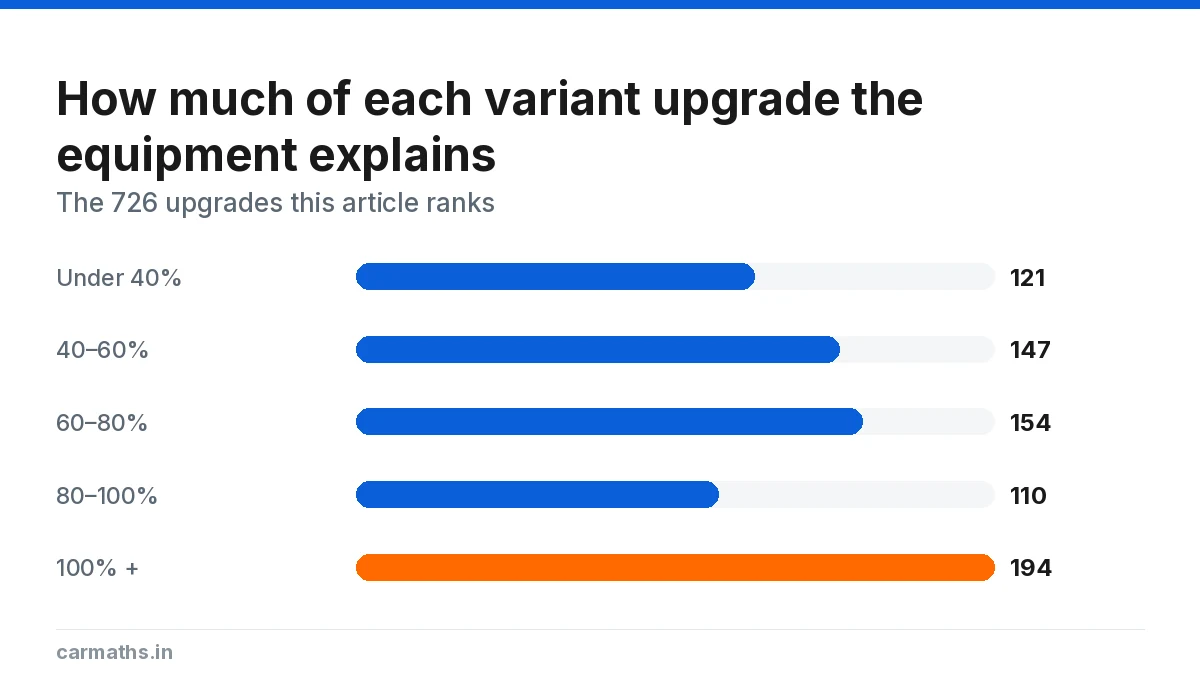
The monthly view, segment by segment, with that month's price changes: Car Variant Value Report India: October 2026.
How this is worked out
We put a rupee value on every feature that differs between two trims, total it, and divide by what the variant costs extra. An upgrade that reaches 100% is one where the equipment alone is worth what you are being asked to pay for it. Every valuation and the reasoning behind it is published at /methodology, and nothing below is chosen by hand — this is all 726 upgrades across 98 cars, sorted.
Only upgrades within one powertrain are ranked. A manual-to-automatic upgrade is not on this list, because a gearbox is not equipment and pricing it as though it were would condemn every automatic in India for the crime of not being a feature. Where a range does change engine as it climbs — the Wagon R moves from the 1.0 to the 1.2, the XUV 3XO from the turbo to the TGDi — and the equipment still covers 60% or more, the row names the power and torque. We do not put a rupee value on either.
7 upgrades also change the engine or the motor, and the equipment covers under 60% of the price. They are left out of both tables. Calling them the upgrades that give back the least would blame the equipment for a price that also buys power. Each comparison names the bhp and Nm instead.
4 upgrades are left out. They are a parallel styling line rather than a move up — Kia's Carens Clavis GTX carries less equipment than the cheaper HTX(O), which is correct data in a pairing that answers nobody's question. It would lead this table every month on a technicality. The car's own page shows it in full.
14 more upgrades change nothing we track at all, so they would read 0% and fill the bottom table. They are 11 different pairs of variants, because some are sold on more than one engine or gearbox. From the cheapest variant they are the Maruti Alto K10 STD(O) → LXi(O), the Maruti Eeco 5-Seater STD → 5-Seater AC, the Toyota Innova Crysta GX → GX+ and the Maruti S-Presso Std(O) → LXi(O), which buy things our registry does not price — often air conditioning and power steering, which it treats as standard. Further up they are the Volkswagen Virtus Highline Plus → GT Line, the Volkswagen Virtus GT Plus → GT Plus Sport, the Skoda Slavia Prestige → Monte Carlo, the Hyundai Grand i10 Nios Magna → Corporate, the Skoda Kushaq Prestige → Monte Carlo, the Kia Carens Clavis EV HTX → GTX and the Volkswagen Taigun GT Plus Chrome → GT Plus Sport, where the money goes on things such as paint, badging, trim and styling. A 0% there measures our registry, not the upgrade, so they are left out of both tables.
The 10 variant upgrades that give back the most
The equipment these add is worth more than the variant costs extra. Where an upgrade is over 100%, the manufacturer is effectively charging less for the kit than the kit is worth — which usually means the trim below it is the one being used to advertise a low starting price.
The Mahindra Thar Roxx Star Edition is ranked here although it is called an edition. It has its own column in the manufacturer's equipment list and carries equipment the variants around it do not, so it is a variant in its own right. Editions that differ only in paint or badging are left out of our data altogether.
The 10 variant upgrades that give back the least
These are not scams, and the money is not vanishing. A variant upgrade also buys materials, fit and finish, and the manufacturer's margin, and none of those are in our registry. What the figure says is narrower and more useful: of what you are paying, this much is explained by equipment anyone can list — and the rest you are taking on trust.
| Upgrade | You pay | Kit worth | Covered |
|---|---|---|---|
| Toyota Fortuner 4x4 → Legender 4x4 Diesel manual 4WD · All Fortuner variants | ₹5,79,000 | ₹8,750 | 1% Pricey |
| Toyota Fortuner 4x2 → Legender 4x2 Diesel automatic · All Fortuner variants | ₹5,36,000 | ₹30,000 | 5% Pricey |
| Tata Sierra Accomplished → Accomplished+ Diesel automatic · All Tata Sierra variants | ₹1,30,000 | ₹14,000 | 10% Pricey |
| Tata Sierra Accomplished → Accomplished+ Diesel manual · All Tata Sierra variants | ₹1,30,000 | ₹14,000 | 10% Pricey |
| Kia Syros EV HTK → HTK+ 42 kWh · Electric · All Syros EV variants | ₹1,50,000 | ₹17,020 | 11% Pricey |
| Citroën C3X Live → Feel 1.2 · Petrol manual · All C3X variants | ₹1,00,900 | ₹11,900 | 11% Pricey |
| Mahindra XUV 7XO AX → AX3 Petrol manual · All XUV 7XO variants | ₹2,38,000 | ₹28,125 | 11% Pricey |
| Maruti Alto K10 LXi(O) → VXi(O) Petrol manual · All Maruti Alto K10 variants | ₹52,500 | ₹7,000 | 13% Pricey |
| Kia Seltos HTX(A) → GTX(A) 1.5 · Petrol IVT · (A) trims · All Seltos variants | ₹1,50,000 | ₹20,000 | 13% Pricey |
| Kia Seltos HTX → GTX 1.5 Turbo · Petrol DCT · All Seltos variants | ₹1,50,000 | ₹20,000 | 13% Pricey |
6 of these 10 are the first upgrade in their engine-and-gearbox range, and that is partly us rather than the manufacturer. Our registry prices the equipment that separates trims, and it is thinnest at the bottom of a range, where an upgrade often buys things nobody lists on a spec sheet — better seat fabric, a rear wiper, sound deadening. Read a low figure at the base of a range as “we cannot itemise much of this”, not as “you get nothing”. Where the method is weakest says more.
What this list is not
It is not a buying recommendation. An upgrade at 30% can still be the right one if the single feature it adds is the one you want, and one at 140% is wasted money if it is all kit you will never use. The number answers “what am I being charged for, and can it be itemised” — which is the question nobody else answers, not “which car should I buy”, which only you can.