Cars With Push-Button Start (No Smart Key) in India
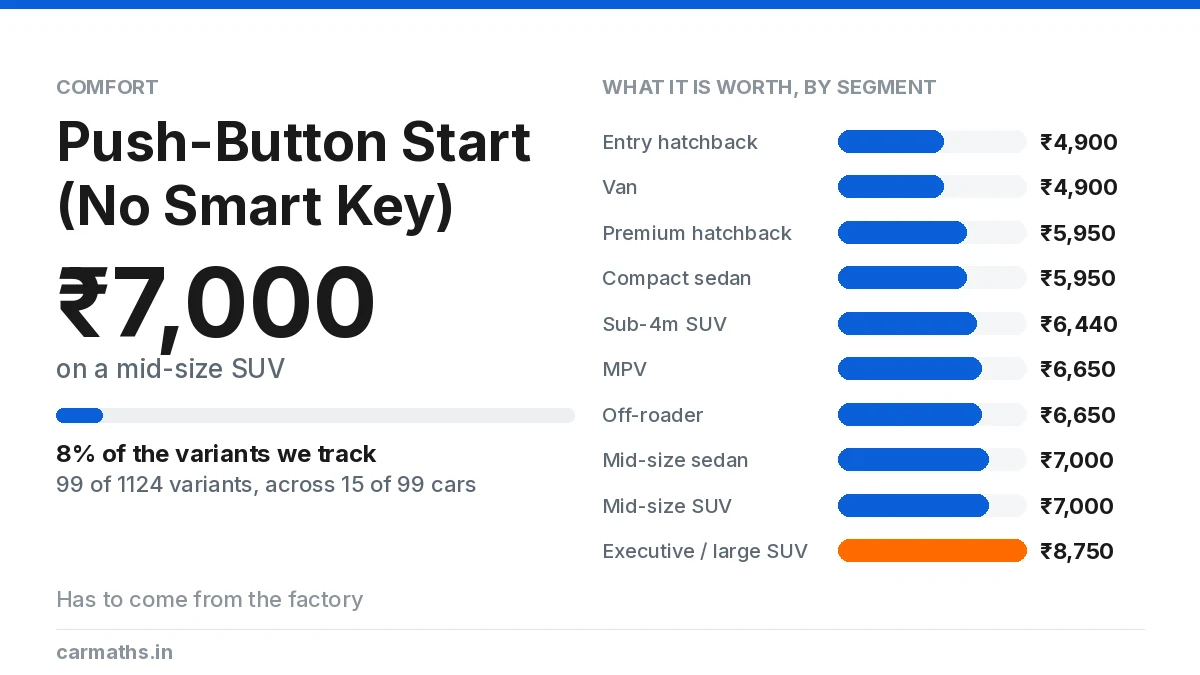
We value Push-Button Start at ₹7,000 on a mid-size SUV, and ₹4,900 to ₹8,750 depending on the segment. 99 of the 1122 variants we track carry it, across 15 of 99 models — the cheapest being the Tata Punch Adventure (Petrol manual) at ₹7,76,990.
*Ex-showroom, Delhi · Prices checked Oct 2026
What is push-button start?
Push-button start lets you start the engine by pressing a button on the dashboard instead of turning a key. This entry is the middle of three levels: you still press a button on the remote key to unlock the car, and only the starting is keyless.
Three levels of locking and starting
The first level is remote central locking: you press a button on the key to lock and unlock, and turn the key to start. The second is push-button start: you still press the key to unlock, but start with a button on the dashboard. The third is smart keyless entry, where the car detects the key nearby and you never need to take it out.
How it works
The key carries a chip the car recognises. With the key inside the car, press the brake or clutch and then the start button, and the engine starts; press the button again to switch off. Once you are in, the key can stay in your pocket.
Starting and stopping
With the key inside the car, press the brake on an automatic, or the clutch on a manual, and press the button to start. Press it once more, with the car stopped, to switch off. Pressing the button without the pedal usually switches on the electrics without starting the engine, which can drain the battery if you leave the car that way.
When the key battery is low
If the car does not detect the key, it shows a warning. Most cars still start if you hold the key against the start button or a marked spot on the console. The key also carries a small metal blade to open the driver's door. The owner's manual shows where.
How common it is, by fuel
Share of the variants we track that carry Push-Button Start.
- Diesel 13% (31 of 225)
- CNG 11% (13 of 112)
- Electric 10% (11 of 103)
- Petrol 6% (44 of 659)
- Strong hybrid 0% (0 of 23)
How we decide a variant has it
We credit it where the variant has a start button but needs the key's button pressed to unlock. A car that also unlocks when you touch the door handle with the key in your pocket earns the level above, smart keyless entry, and a variant holds one of the three levels.
What to check at the showroom
- Try the door handle with the key in your pocket; if it unlocks, the car has the level above.
- Ask how to start the car if the key's battery goes flat.
- Check the start button is easy to reach from your driving position.
Written by Rupesh Kumar · explanation reviewed
Standard, extra, or left out
34 cars have push-button start on every version (or something better). On 57 cars it comes only on some versions, so you pay to climb to it. 8 cars do not offer it, or anything better, on any version.
Not offered on: Maruti Wagon R, Maruti Alto K10, Maruti Eeco, Mahindra Scorpio Classic, Mahindra Bolero, Mahindra Bolero Neo, Renault Kwid, Maruti S-Presso.
The valuation
₹7,000Engine started by a button, with a remote key that still has to be pressed to unlock. No passive entry.
Why this number: A body-control-module and immobiliser change. Priced below the smart key, which adds passive entry — walking up and opening the car without touching the key is the part buyers actually notice.
A reference point exists, but not for the identical item. This is what the feature is worth to a buyer who wants it — not what it costs a manufacturer to fit, which nobody outside the factory knows and which would not help you anyway. How we arrive at every figure.
What it is worth on each kind of car
The same feature is worth less on a cheaper car: the buyer is more price-sensitive and it is a larger share of what they are paying.
What the level below and above are worth
A variant carries one of these, not several, so moving between them is a single upgrade worth the difference — not a feature gained and another lost. That is why a trim that swaps remote central locking for push-button start is credited with the gap between them, and why the page it appears on does not claim it lost anything.
- Remote Central LockingFrom the Maruti S-Presso VXi(O), ₹4,32,400₹5,000
- Push-Button StartFrom the Tata Punch Adventure, ₹7,76,990₹7,000 +₹2,000 on the level below
- Smart Keyless Entry & Push Button StartFrom the Maruti Celerio ZXi+, ₹6,30,400₹12,000 +₹5,000 on the level below
41 variant upgrades on this site add it
Every one of them bundles it with other equipment, so none of these price differences is the price of this feature on its own. The upgrades that change the least besides it are listed first — they are the ones that tell you most.
| The upgrade | It costs | We value this at | Also changes | Verdict |
|---|---|---|---|---|
| Tigor XZ → XZ+ Tata Motors · Petrol manual | ₹55,000 | ₹5,950 | 5 other items | Fair upgrade |
| Tigor XZ → XZ+ Tata Motors · Petrol AMT | ₹55,000 | ₹5,950 | 5 other items | Fair upgrade |
| Tigor XZ → XZ+ Tata Motors · CNG manual | ₹55,000 | ₹5,950 | 5 other items | Fair upgrade |
| Tigor XZ → XZ+ Tata Motors · CNG AMT | ₹55,000 | ₹5,950 | 5 other items | Fair upgrade |
| Nexon Pure+ → Creative Tata Motors · CNG manual | ₹1,22,000 | ₹1,840 up from Remote Central Locking | 5 other items | Fair upgrade |
| Nexon Pure+ S → Creative+ S Tata Motors · CNG manual | ₹1,52,000 | ₹1,840 up from Remote Central Locking | 5 other items | Pricey |
| Punch Pure+ S → Adventure S Tata Motors · Petrol manual | ₹60,000 | ₹1,840 up from Remote Central Locking | 6 other items | Worth it |
| Punch Pure+ S → Adventure S Tata Motors · CNG manual | ₹60,000 | ₹1,840 up from Remote Central Locking | 6 other items | Worth it |
| Nexon Pure+ → Creative Tata Motors · Petrol manual | ₹1,10,000 | ₹1,840 up from Remote Central Locking | 6 other items | Fair upgrade |
| Nexon Pure+ S → Creative+ S Tata Motors · Petrol manual | ₹1,10,000 | ₹1,840 up from Remote Central Locking | 6 other items | Fair upgrade |
| Nexon Pure+ S → Creative+ S Tata Motors · Diesel manual | ₹1,10,000 | ₹1,840 up from Remote Central Locking | 6 other items | Fair upgrade |
| Nexon Pure+ → Creative Tata Motors · Diesel AMT | ₹1,10,000 | ₹1,840 up from Remote Central Locking | 6 other items | Fair upgrade |
Showing the 12 with the fewest other changes, of 41. Every upgrade is listed on its car's own page, linked in the table below.
The cheapest variant of each car that has it
The last column is what that variant costs over the car's own entry price. It is not the price of this feature — climbing to that trim buys everything else on the way up too. It is the honest answer to “what do I have to spend on this car to get one?”
| Car | Cheapest variant with it | Ex-showroom | Over the base trim | Variants |
|---|---|---|---|---|
| Tata TigorReplaced by the Tata Aeris | XZ+ Petrol manual | ₹7,54,990 | +₹1,85,000 | 6 of 14 |
| Tata Punch | Adventure Petrol manual | ₹7,76,990 | +₹2,02,000 | 8 of 26 |
| Renault Triber | Emotion Petrol manual | ₹8,05,350 | +₹2,24,475 | 3 of 8 |
| Tata Altroz | Creative Petrol manual | ₹8,09,990 | +₹2,10,000 | 10 of 27 |
| Tata Nexon | Creative Petrol manual | ₹10,16,990 | +₹2,77,000 | 11 of 44 |
| Mahindra Thar OG | AXT Diesel manual | ₹10,32,000 | standard fit | 15 of 15 |
| Honda City | SV Petrol manual | ₹11,99,900 | standard or better | 1 of 8 |
| Mahindra Thar Roxx | MX1 Petrol manual | ₹12,52,000 | standard or better | 6 of 21 |
| Maruti Jimny | Alpha Pro Petrol manual 4WD | ₹13,45,700 | +₹86,700 | 2 of 4 |
| Mahindra XUV 7XO | AX Petrol manual | ₹13,99,000 | standard or better | 6 of 20 |
| Tata Harrier | Pure X Petrol manual | ₹16,39,990 | +₹3,40,000 | 12 of 26 |
| Tata Safari | Pure X Petrol manual | ₹16,84,990 | +₹3,45,000 | 8 of 22 |
| Mahindra BE 6 | One Electric 59 kWh | ₹19,45,000 | standard or better | 4 of 7 |
| Mahindra XEV 9S | One Above Electric 59 kWh | ₹20,65,000 | standard or better | 4 of 6 |
| Mahindra XEV 9e | Pack One Electric 59 kWh | ₹21,90,000 | standard or better | 3 of 5 |
Ex-showroom, Delhi. How we read each car's prices and equipment, and how often we re-check them: where the numbers come from.
Common questions
- What is push-button start?
- Push-button start lets you start the engine by pressing a button on the dashboard instead of turning a key. This entry is the middle of three levels: you still press a button on the remote key to unlock the car, and only the starting is keyless.
- What is the difference between push-button start and keyless entry?
- Push-button start only replaces turning the key. Keyless entry, our level above, also unlocks the doors when you touch the handle with the key in your pocket.
- What happens if the key battery dies?
- Hold the key against the start button or the marked spot shown in the owner's manual, and the car usually starts. Use the metal blade in the key to open the door.
- Can I switch off the engine while driving?
- Most cars need the button held down for a few seconds, or pressed several times, to stop the engine on the move, so it cannot happen by accident. Do it only in an emergency.
- Does push-button start drain the car battery?
- Not by itself. Leaving the car in accessory or ignition mode, without the engine running, can drain it.
- What is push-button start worth in a car?
- CarMaths values it at ₹7,000 on a mid-size SUV, scaling to ₹4,900 on the cheapest segment and ₹8,750 on the most expensive. A body-control-module and immobiliser change. Priced below the smart key, which adds passive entry — walking up and opening the car without touching the key is the part buyers actually notice.
- Can push-button start be added after you buy the car?
- No. It has to come from the factory, so the trim that has it is the only way to get it. That is why the figure is what the feature is worth to you rather than what it costs to fit.
- Which is the cheapest car with push-button start?
- Of the 99 cars CarMaths tracks, the cheapest variant carrying it is the Tata Punch Adventure (Petrol manual) at ₹7,76,990 ex-showroom, which is ₹2,02,000 above that car's entry price.
- What does a variant upgrade that adds push-button start cost?
- The typical step that adds it costs ₹1,00,000, across 41 such upgrades — but every one of those upgrades adds other equipment too, so that figure is the price of the whole gap, not of this feature.