Cars With Hill Descent Control in India
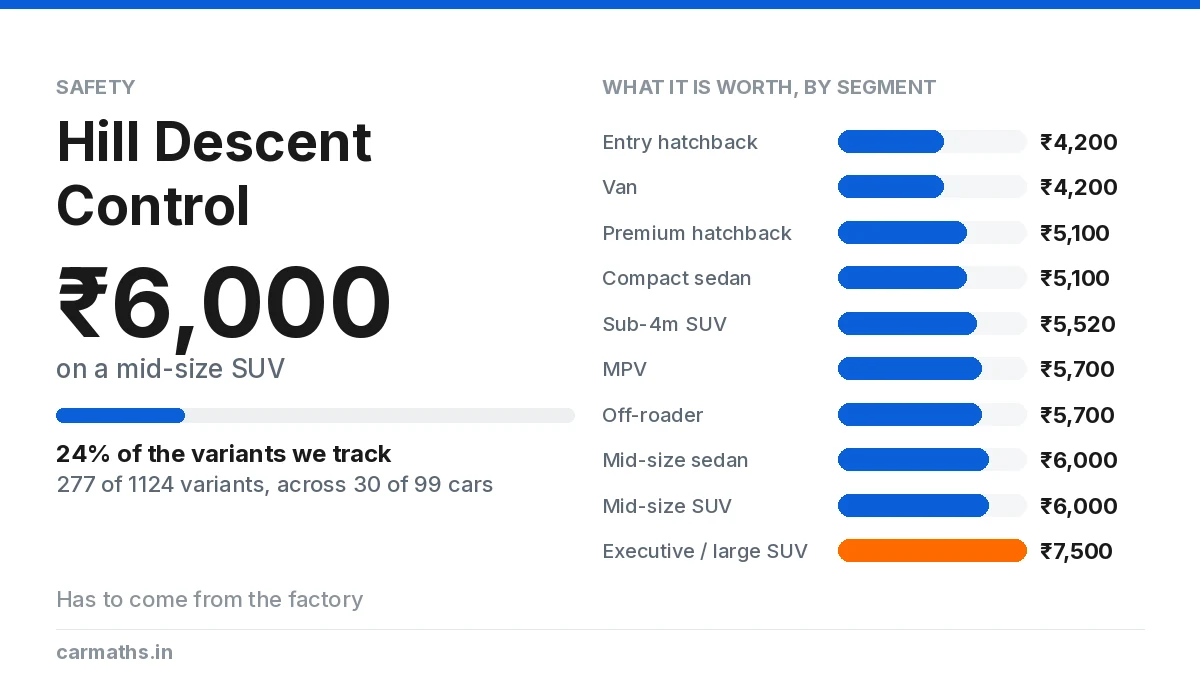
We value Hill Descent Control at ₹6,000 on a mid-size SUV, and ₹4,200 to ₹7,500 depending on the segment. 275 of the 1122 variants we track carry it, across 30 of 99 models — the cheapest being the Tata Punch Accomplished (Petrol manual) at ₹8,46,990.
*Ex-showroom, Delhi · Prices checked Oct 2026
What is hill descent control?
Hill descent control holds the car at a slow, steady crawl down a steep slope without you touching the brake pedal. You steer; the car works the brakes on each wheel to stop it running away.
How it works
Switch it on and, below a low speed, the system uses the ABS and stability-control hardware to brake individual wheels so the car creeps down slowly. On many cars you can raise or lower that speed with the accelerator, the brake or the cruise buttons.
Because it brakes each wheel separately, it keeps control when one wheel is on loose gravel or mud and another is not.
Where it helps
It is built for steep, loose descents: a broken hill road, a ghat section after rain, a riverbed or a sandy slope. On an ordinary tarmac slope you will not need it. It is common on four-wheel drives, but plenty of two-wheel-drive cars carry it too.
Hill descent control or hill-start assist
They are easy to confuse. Hill-start assist helps you move off uphill without rolling back, for a second or two. Hill descent control works going down: it holds a slow, steady speed on a steep slope for as long as you leave it on. A car can have either, both or neither.
Without four-wheel drive
Most cars with hill descent control in our data are two-wheel drive. On those it still keeps a descent slow and controlled, which helps on a broken hill road or a muddy slope after rain. It cannot give the car grip it does not have going up, and ground clearance still decides where you can go.
How common it is, by fuel
Share of the variants we track that carry Hill Descent Control.
- Diesel 48% (108 of 225)
- Electric 44% (46 of 103)
- Petrol 17% (117 of 659)
- CNG 3% (4 of 112)
- Strong hybrid 0% (0 of 23)
Where it depends on the version, not just the trim
On these cars, a trim carries it with one gearbox, fuel or battery and not another.
- Maruti Victoris · ZXi+, ZXi+(O)
- Hyundai Alcazar · Prestige, Corporate
- Renault Duster · Iconic
- Nissan Tekton · Tekna, Tekna+
- Jeep Compass · Model S (O2)
- Jeep Meridian · Overland
How we decide a variant has it
We credit it where the manufacturer lists hill descent control on that variant. Where a manufacturer fits it only to the four-wheel-drive versions of a trim, only those versions get it.
What to check at the showroom
- Find the button, usually marked with a car on a slope, and ask at what speed it works.
- Check it is on your exact version; on some cars it comes only with four-wheel drive.
- If the test drive allows, try it on a steep ramp: the car should creep down with your feet off the pedals.
Written by Rupesh Kumar · explanation reviewed
Standard, extra, or left out
16 cars have hill descent control on every version. On 14 cars it comes only on some versions, so you pay to climb to it. 69 cars do not offer it on any version.
The valuation
₹6,000Holds a steady crawling speed down a steep slope without the brake pedal.
Why this number: Brake and engine control logic in the stability-control module. No aftermarket equivalent.
No purchasable equivalent — an estimate of worth, not of cost. Low confidence means the figure is our judgement, not a shop price — which is why the upgrades below show what manufacturers actually charge for it: that is the check on our number. This is what the feature is worth to a buyer who wants it — not what it costs a manufacturer to fit, which nobody outside the factory knows and which would not help you anyway. How we arrive at every figure.
What it is worth on each kind of car
The same feature is worth less on a cheaper car: the buyer is more price-sensitive and it is a larger share of what they are paying.
32 variant upgrades on this site add it
Every one of them bundles it with other equipment, so none of these price differences is the price of this feature on its own. The upgrades that change the least besides it are listed first — they are the ones that tell you most.
| The upgrade | It costs | We value this at | Also changes | Verdict |
|---|---|---|---|---|
| Meridian Limited (O) → Overland Jeep · Diesel automatic 4WD | ₹1,87,000 | ₹7,500 | 3 other items | Fair upgrade |
| Punch EV Smart+ → Adventure Tata Motors · Electric 40 kWh | ₹75,000 | ₹5,520 | 4 other items | Pricey |
| Safari Accomplished X → Accomplished X+ Tata Motors · Petrol automatic | ₹1,60,000 | ₹7,500 | 5 other items | Pricey |
| Safari Accomplished X → Accomplished X+ Tata Motors · Diesel automatic | ₹1,60,000 | ₹7,500 | 5 other items | Pricey |
| Safari Accomplished X → Accomplished X+ Tata Motors · Petrol manual | ₹1,75,000 | ₹7,500 | 5 other items | Pricey |
| Harrier Fearless X → Fearless X+ Tata Motors · Petrol automatic | ₹1,80,000 | ₹7,500 | 5 other items | Pricey |
| Safari Accomplished X → Accomplished X+ Tata Motors · Diesel manual | ₹1,80,000 | ₹7,500 | 5 other items | Pricey |
| Harrier Fearless X → Fearless X+ Tata Motors · Diesel automatic | ₹1,90,000 | ₹7,500 | 5 other items | Pricey |
| Harrier Fearless X → Fearless X+ Tata Motors · Diesel manual | ₹2,00,000 | ₹7,500 | 5 other items | Pricey |
| Harrier Fearless X → Fearless X+ Tata Motors · Petrol manual | ₹2,10,000 | ₹7,500 | 5 other items | Pricey |
| Curvv Creative X+ → Accomplished X Tata Motors · Petrol manual | ₹1,09,000 | ₹6,000 | 6 other items | Fair upgrade |
| Curvv Creative X+ → Accomplished X Tata Motors · Petrol DCA | ₹1,09,000 | ₹6,000 | 6 other items | Fair upgrade |
Showing the 12 with the fewest other changes, of 32. Every upgrade is listed on its car's own page, linked in the table below.
The cheapest variant of each car that has it
The last column is what that variant costs over the car's own entry price. It is not the price of this feature — climbing to that trim buys everything else on the way up too. It is the honest answer to “what do I have to spend on this car to get one?”
| Car | Cheapest variant with it | Ex-showroom | Over the base trim | Variants |
|---|---|---|---|---|
| Tata Punch | Accomplished Petrol manual | ₹8,46,990 | +₹2,72,000 | 7 of 26 |
| MG Astor | Sprint Petrol manual | ₹9,79,100 | standard fit | 7 of 7 |
| Mahindra Thar OG | AXT Diesel manual | ₹10,32,000 | standard fit | 15 of 15 |
| Kia Seltos | HTE Petrol manual | ₹11,24,900 | standard fit | 33 of 33 |
| Kia Carens Clavis | HTE Petrol manual | ₹11,38,900 | standard fit | 22 of 22 |
| Tata Punch EV | Adventure Electric 40 kWh | ₹11,94,000 | +₹2,15,000 | 3 of 6 |
| Mahindra Thar Roxx | MX1 Petrol manual | ₹12,52,000 | standard fit | 21 of 21 |
| Maruti Jimny | Zeta Pro Petrol manual 4WD | ₹12,59,000 | standard fit | 4 of 4 |
| Tata Sierra | Pure Petrol manual | ₹13,14,000 | +₹1,65,000 | 32 of 36 |
| Mahindra Scorpio N | Z2 Petrol manual | ₹13,69,000 | standard fit | 27 of 27 |
| Mahindra XUV 7XO | AX Petrol manual | ₹13,99,000 | standard fit | 20 of 20 |
| Tata Curvv | Accomplished X Petrol manual | ₹13,99,990 | +₹4,00,000 | 5 of 15 |
| MG Windsor EV | Excite Electric 38 kWh | ₹14,84,800 | standard fit | 5 of 5 |
| Nissan Tekton | Tekna Petrol DCT | ₹17,79,000 | +₹7,30,000 | 2 of 12 |
| MG ZS EV | Executive Electric 50.3 kWh | ₹17,99,000 | standard fit | 4 of 4 |
| Hyundai Creta Electric | Executive Electric 42 kWh | ₹18,02,800 | standard fit | 8 of 8 |
| Kia Carens Clavis EV | HTK+ Electric 42 kWh | ₹18,03,900 | standard fit | 8 of 8 |
| Maruti Grand Vitara | Alpha ALLGRIP Petrol automatic 4WD | ₹18,04,700 | +₹7,28,200 | 2 of 18 |
| Hyundai Alcazar | Prestige Petrol DCT | ₹18,08,300 | +₹3,57,600 | 6 of 10 |
| Renault Duster | Iconic Petrol DCT | ₹18,49,000 | +₹8,00,000 | 1 of 14 |
| Maruti Victoris | ZXi+ Petrol automatic 4WD | ₹18,68,900 | +₹8,19,000 | 2 of 21 |
| Tata Sierra EV | Pure Electric 63 kWh | ₹18,79,000 | standard fit | 8 of 8 |
| Tata Harrier EV | Adventure Electric 65 kWh | ₹21,79,000 | standard fit | 7 of 7 |
| Tata Harrier | Fearless X+ Petrol manual | ₹22,34,990 | +₹9,35,000 | 8 of 26 |
| Tata Safari | Accomplished X+ Petrol manual | ₹23,04,990 | +₹9,65,000 | 8 of 22 |
| BYD Atto 3 | Dynamic Electric 49.92 kWh | ₹24,99,000 | standard fit | 3 of 3 |
| Jeep Compass | Model S (O2) Diesel automatic 4WD | ₹30,70,000 | +₹12,41,000 | 1 of 9 |
| Jeep Meridian | Overland Diesel automatic 4WD | ₹37,92,000 | +₹14,59,000 | 1 of 9 |
| Toyota Fortuner | 4x4 Diesel manual 4WD | ₹39,74,000 | +₹4,63,000 | 3 of 7 |
| MG Majestor | Savvy 4x2 Diesel automatic | ₹43,49,000 | standard fit | 2 of 2 |
Ex-showroom, Delhi. How we read each car's prices and equipment, and how often we re-check them: where the numbers come from.
Common questions
- What is hill descent control?
- Hill descent control holds the car at a slow, steady crawl down a steep slope without you touching the brake pedal. You steer; the car works the brakes on each wheel to stop it running away.
- What is the difference between hill descent control and hill hold?
- Hill hold, or hill-start assist, stops the car rolling back for a moment when you move off uphill. Hill descent control holds a slow, steady speed down a steep slope until you switch it off.
- Do I need hill descent control without 4WD?
- It is not essential, but it helps on steep, loose hill roads, where braking by foot can lock a wheel. Most cars that have it are two-wheel drive.
- How do you use hill descent control?
- Press the button, usually marked with a car on a slope, and drive onto the descent at a crawl. Keep your feet off the pedals and steer; on many cars you can change the speed with the accelerator, the brake or the cruise buttons.
- Does hill descent control work in reverse?
- On many cars, yes. Check the owner's manual, as the speed range differs by car.
- What is hill descent control worth in a car?
- CarMaths values it at ₹6,000 on a mid-size SUV, scaling to ₹4,200 on the cheapest segment and ₹7,500 on the most expensive. Brake and engine control logic in the stability-control module. No aftermarket equivalent.
- Can hill descent control be added after you buy the car?
- No. It has to come from the factory, so the trim that has it is the only way to get it. That is why the figure is what the feature is worth to you rather than what it costs to fit.
- Which is the cheapest car with hill descent control?
- Of the 99 cars CarMaths tracks, the cheapest variant carrying it is the Tata Punch Accomplished (Petrol manual) at ₹8,46,990 ex-showroom, which is ₹2,72,000 above that car's entry price.
- What does a variant upgrade that adds hill descent control cost?
- The typical step that adds it costs ₹1,65,000, across 32 such upgrades — but every one of those upgrades adds other equipment too, so that figure is the price of the whole gap, not of this feature.