Of the 98 cars we track, 7 sell a strong hybrid, across 23 variants. The cheapest way into one is the Maruti Victoris VXi at ₹16,42,900 ex-showroom.
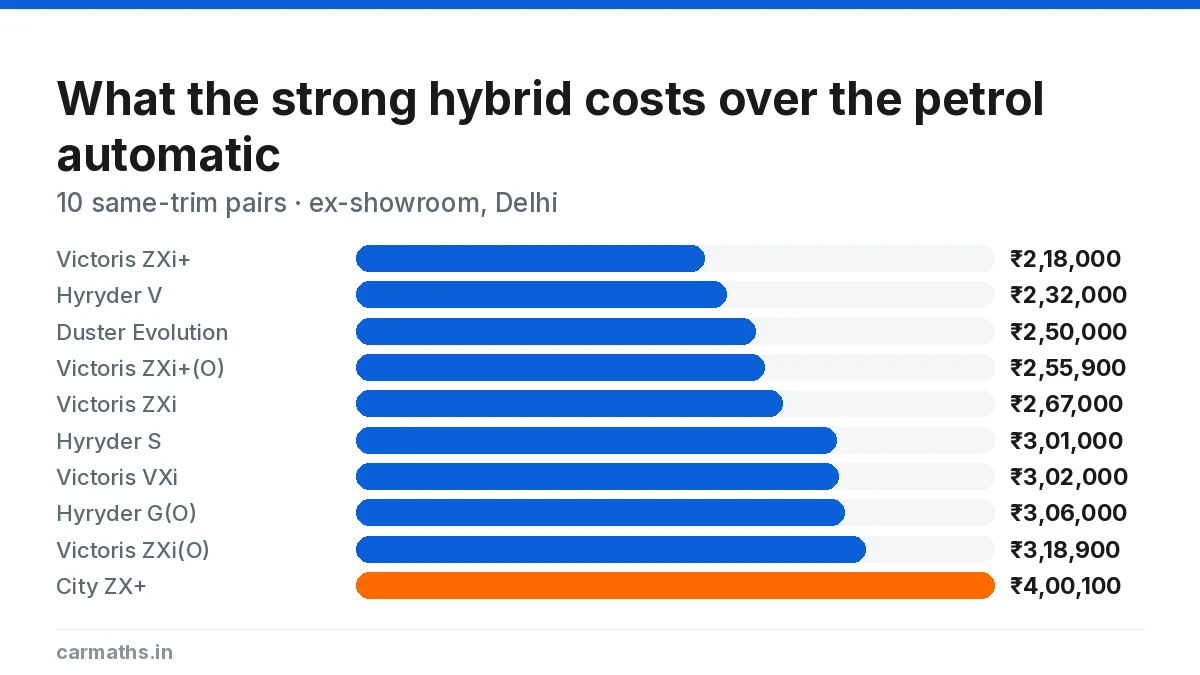
Measured against the same trim sold as a petrol automatic, the hybrid costs a median ₹2,84,000 more, across 10 pairs on 4 cars. At Delhi's petrol price of ₹102.12 a litre, the fuel it saves repays that in 2,06,593 km to 2,35,092 km on each car's cheapest hybrid — 17 to 20 years at 12,000 km a year. Across the 9 of those 10 pairs that carry a certified efficiency on both sides, dearer trims included, it is 1,69,702 km to 2,48,248 km (14 to 21 years); the table below shows why the two ranges differ.
How long it takes, at how far you drive
The kilometres are fixed by the two certified figures and the petrol price; the years depend on how much you drive. Each car's cheapest hybrid against its petrol automatic, at Delhi's ₹102.12 a litre.
| Car | Payback | 10k km/yr | 15k km/yr | 20k km/yr |
|---|---|---|---|---|
| Honda CityZX+ | 2,06,593 km | 20.7 yrs | 13.8 yrs | 10.3 yrs |
| Toyota Urban Cruiser HyryderS | 2,29,588 km | 23.0 yrs | 15.3 yrs | 11.5 yrs |
| Maruti VictorisVXi | 2,35,092 km | 23.5 yrs | 15.7 yrs | 11.8 yrs |
Every strong hybrid we track
| Car | Hybrid variants | Certified km/l | From |
|---|---|---|---|
| Maruti VictorisEvery powertrain | 5 | 28.65 | ₹16,42,900 |
| Maruti Grand VitaraEvery powertrain | 5 | 27.97 | ₹16,68,300 |
| Renault DusterEvery powertrain | 3 | 29 | ₹16,99,000 |
| Toyota Urban Cruiser HyryderEvery powertrain | 3 | 27.97 | ₹17,18,000 |
| Honda CityEvery powertrain | 1 | 27.26 | ₹21,35,800 |
| Maruti Invicto | 2 | 22.16 | ₹25,02,400 |
| Toyota Innova HycrossEvery powertrain | 4 | 22.16 | ₹26,76,000 |
Ex-showroom, Delhi. Efficiency is the manufacturer's certified figure, not a road test.
The Maruti Grand Vitara, the Toyota Urban Cruiser Hyryder and the Maruti Victoris carry identical output — 114 bhp and 122 Nm from 1490 cc — because they share one strong-hybrid system. Between them the choice is price and equipment, not the hybrid.
What the hybrid costs, and when it pays back
The comparison is the same trim sold as a petrol automatic, not the manual. A strong hybrid shifts itself, so pricing it against a manual would put a gearbox into the premium as well, which is the trap our guide to what an automatic costs is built to avoid. Both burn petrol, so the saving is the difference in certified efficiency alone, and the payback is the premium divided by what that saves per kilometre.
| Hybrid variant | Costs more | km/l, hybrid vs petrol | Fuel saved a year | Pays back in |
|---|---|---|---|---|
| Maruti Victoris ZXi+against the petrol automatic · gives up 4 features28.65 vs 21.06 km/l | ₹2,18,000 | 28.65 vs 21.06 | ₹15,415 | 1,69,702 kmabout 14 years |
| Toyota Urban Cruiser Hyryder Vagainst the petrol automatic · gives up 2 features27.97 vs 20.58 km/l | ₹2,32,000 | 27.97 vs 20.58 | ₹15,733 | 1,76,958 kmabout 15 years |
| Maruti Victoris ZXi+(O)against the petrol automatic · gives up 4 features28.65 vs 21.06 km/l | ₹2,55,900 | 28.65 vs 21.06 | ₹15,415 | 1,99,205 kmabout 17 years |
| Honda City ZX+against the petrol CVT27.26 vs 17.97 km/l | ₹4,00,100 | 27.26 vs 17.97 | ₹23,240 | 2,06,593 kmabout 17 years |
| Maruti Victoris ZXiagainst the petrol automatic · gives up 2 features28.65 vs 21.06 km/l | ₹2,67,000 | 28.65 vs 21.06 | ₹15,415 | 2,07,846 kmabout 17 years |
| Toyota Urban Cruiser Hyryder Sagainst the petrol automatic · gives up 2 features27.97 vs 20.58 km/l | ₹3,01,000 | 27.97 vs 20.58 | ₹15,733 | 2,29,588 kmabout 19 years |
| Toyota Urban Cruiser Hyryder G(O)against the petrol automatic · gives up 2 features27.97 vs 20.58 km/l | ₹3,06,000 | 27.97 vs 20.58 | ₹15,733 | 2,33,402 kmabout 19 years |
| Maruti Victoris VXiagainst the petrol automatic · gives up 2 features28.65 vs 21.06 km/l | ₹3,02,000 | 28.65 vs 21.06 | ₹15,415 | 2,35,092 kmabout 20 years |
| Maruti Victoris ZXi(O)against the petrol automatic · gives up 2 features28.65 vs 21.06 km/l | ₹3,18,900 | 28.65 vs 21.06 | ₹15,415 | 2,48,248 kmabout 21 years |
Delhi petrol at ₹102.12 a litre, read 4 Nov 2026; 12,000 km a year, the same default our running-cost panel uses. Premiums are ex-showroom. 1 pair not shown: the manufacturer publishes no certified efficiency for one side, and we do not lend one.
Read the top of that table with care. Across the 9 pairs we can compute, the payback runs from 1,69,702 km on the Maruti Victoris ZXi+ to 2,48,248 km on the Maruti Victoris ZXi(O). But the quickest is quick partly because its hybrid carries less than its petrol twin — it gives up 4 features the petrol automatic has, so the smaller premium is not all saving. The range at the top of this page quotes each car's cheapest hybrid instead. The premium is not one price per car either, so where a trim sits matters as much as the equipment: on the Maruti Victoris it runs from ₹2,18,000 (ZXi+) to ₹3,18,900 (ZXi(O)) and on the Toyota Urban Cruiser Hyryder it runs from ₹2,32,000 (V) to ₹3,06,000 (G(O)).
The hybrid is not always the same car
In 9 of the 10 pairs, the hybrid variant gives up equipment that the petrol automatic of the same trim carries. You pay more and, on these, get less of what we track. Check the list before you compare the two on fuel alone.
| Car | Hybrid trims | What the hybrid goes without |
|---|---|---|
| Maruti Victoris | ZXi+, ZXi+(O) | Level 2 ADAS Suite, Steering Mounted Paddle Shifters, Electronic Parking Brake with Auto Hold, Blind Spot Monitor |
| Toyota Urban Cruiser Hyryder | V, S, G(O) | Steering Mounted Paddle Shifters, Electronic Parking Brake with Auto Hold |
| Renault Duster | Evolution | 17-Inch Alloy Wheels, Steering Mounted Paddle Shifters |
| Maruti Victoris | ZXi, VXi, ZXi(O) | Steering Mounted Paddle Shifters, Electronic Parking Brake with Auto Hold |
How the answer moves with your petrol price
Dearer petrol makes the hybrid pay back sooner. At the dearest petrol in the states we hold a price for — Telangana, ₹116.15 a litre — the same 9 pairs pay back in 1,49,203 km to 2,18,261 km, or 12 to 18 years. At the cheapest — Andaman and Nicobar Islands, ₹88.66 — it is 1,95,465 km to 2,85,935 km, or 16 to 24 years.
Driving is the bigger lever. The payback distance does not change with how much you drive, but the years do: double the 12,000 km and every figure in years above halves. On these figures the hybrid repays its premium only for someone who drives a great deal; otherwise the reason to buy one is how it drives in traffic, not the fuel bill.
A mild hybrid is not a strong hybrid
39 petrol variants on 4 cars carry the words “Mild Hybrid” in their name — the Maruti Brezza, the Maruti Grand Vitara, the Toyota Urban Cruiser Hyryder and the Maruti Victoris. A mild hybrid has a small battery that helps the engine; it cannot drive the car on electric power alone. We count it as petrol, and none of it appears in the tables above except as the comparison.
That comparison is the clearest way to see the difference. On the Maruti Victoris and the Toyota Urban Cruiser Hyryder, the petrol automatic each strong hybrid is measured against is itself badged mild hybrid — and the certified efficiencies in the table are what separate the two.
Maruti Brezza · Maruti Grand Vitara · Toyota Urban Cruiser Hyryder · Maruti Victoris
Where there is no petrol twin to compare
13 hybrid variants are sold on trims that have no petrol version of the same name, so there is no premium to measure and we do not print one: the Maruti Grand Vitara Delta+, Zeta+, Zeta+(O), Alpha+, Alpha+(O), the Toyota Innova Hycross VX, VX(O), ZX, ZX(O), the Renault Duster Techno, Emotion and the Maruti Invicto Zeta+, Alpha+. On those the hybrid is the trim, and the car's own page scores each variant against the next.
What this does not account for
Certified efficiency is measured on a rolling road, and nobody quite gets it. What matters is the gap between the two figures rather than either one, but a hybrid's advantage is largest in slow traffic and smallest on the highway, so how you drive moves the real gap.
The premium here is ex-showroom. On the road it is larger, because our on-road figures charge road tax and insurance as a share of the price — and they tax a strong hybrid at the petrol rate. A state concession for hybrids would shorten the payback; we do not model one. We also do not price battery life, servicing or resale, so this is the fuel arithmetic and nothing more.
Each car's powertrains page lays its hybrid beside its petrol and other versions, trim by trim: Maruti Grand Vitara · Honda City · Toyota Urban Cruiser Hyryder · Maruti Victoris · Toyota Innova Hycross · Renault Duster. Every feature valuation is on the methodology page.