Cars With Level 2 ADAS in India
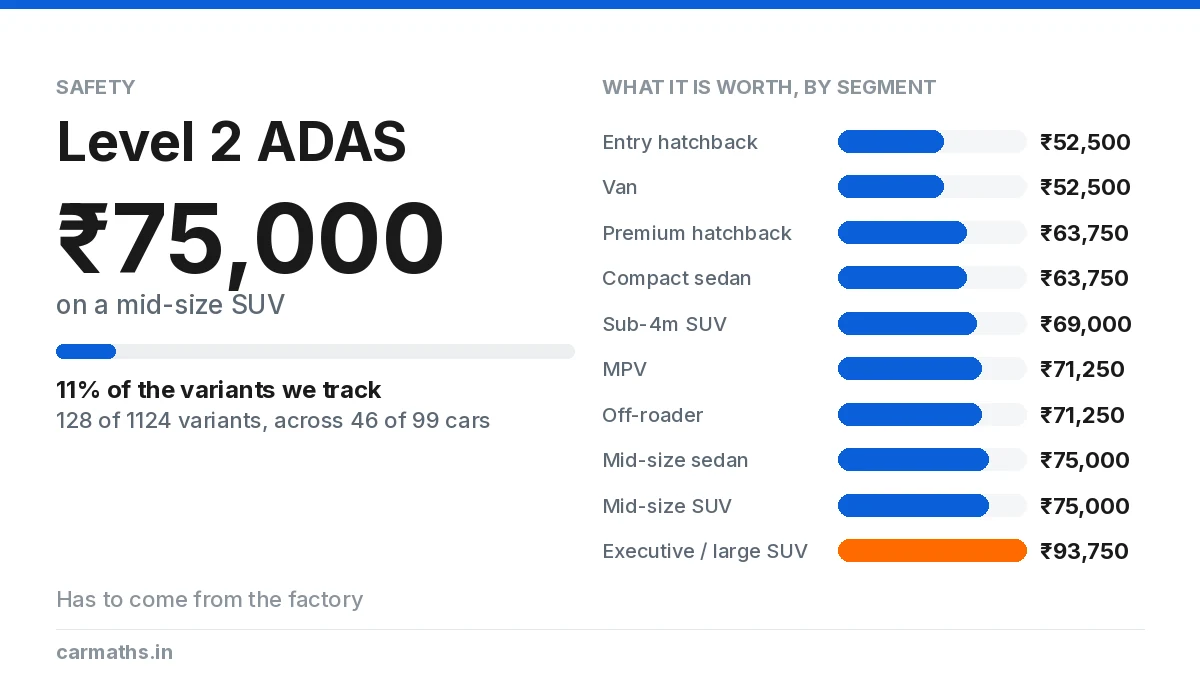
We value Level 2 ADAS Suite at ₹75,000 on a mid-size SUV, and ₹52,500 to ₹93,750 depending on the segment. 128 of the 1122 variants we track carry it, across 46 of 99 models — the cheapest being the Honda Amaze ZX (Petrol manual) at ₹9,39,400.
*Ex-showroom, Delhi · Prices checked Oct 2026
What is Level 2 ADAS?
ADAS stands for Advanced Driver Assistance Systems: cameras and radar that watch the road and can brake or steer for you. Level 2 means the car can control its speed and its steering at the same time, while you keep your hands on the wheel and stay responsible for the driving.
What the systems do
Automatic emergency braking watches for a vehicle or pedestrian ahead and brakes if you do not. Lane keep assist nudges the steering when the car drifts out of its lane without an indicator. Adaptive cruise control holds a set speed but slows down to keep a gap to the vehicle in front, and with stop and go it can follow traffic down to a halt.
Most suites add warnings on top: forward collision warning, lane departure warning, blind-spot alerts and a prompt when the car ahead moves off. Manufacturers count these as separate features, which is why one brochure can claim a much longer list than another for broadly the same hardware.
What it does not do
Level 2 is driver assistance, not self-driving. The systems depend on clear lane markings and a clean view for the camera, so faded paint, heavy rain, dust or a dirty windscreen can switch them off or make them less reliable. The car warns you and hands control back; it does not drive itself.
Level 1, Level 2 and "Level 2+"
The levels come from SAE International's J3016 standard. Level 1 controls one thing at a time: adaptive cruise for the speed, or lane keep for the steering. Level 2 controls both together, while the driver supervises the whole time.
"Level 2+" is not an SAE level. Manufacturers use it for Level 2 systems with extras such as lane centring, traffic-jam assist or a speed limit read from the map, and each brand names its package differently. We credit every one of them by the same three systems, whatever the badge says.
Lane keep or lane centring
Lane keep assist steers you back when the car drifts towards a line. Lane centring, which some makers call lane following assist, keeps steering to hold the middle of the lane, which is the more useful of the two on a long highway drive. Both count here, provided adaptive cruise and emergency braking come with them. Most systems only steer above a minimum speed, which the owner's manual states.
Camera, or camera and radar
A camera reads lane lines and recognises vehicles and people. A radar measures distance and closing speed directly, and is less affected by glare and darkness. Many cars in India pair a front camera with a millimetre-wave radar, and some use the camera alone. We credit both the same way: what we count is the three systems, not the hardware behind them.
On Indian roads
Manufacturers' own documents say the systems' performance varies with road and driving conditions, and that the driver stays responsible. In practice they work best on a marked highway. In dense traffic, a two-wheeler or an auto-rickshaw cutting into the gap can make adaptive cruise react late or abruptly, and collision alerts can be frequent, which is why most cars let you change their sensitivity or switch individual alerts off.
Rules and testing in India
No Indian body certifies a car as "Level 2": the label is the manufacturer's. The government's next crash-test programme, Bharat NCAP 2.0, is planned from October 2027 and its draft includes an assessment of ADAS; today's Bharat NCAP star ratings do not test these systems. However much the car does, the driver remains legally responsible for it.
How common it is, by fuel
Share of the variants we track that carry Level 2 ADAS Suite.
- Electric 31% (32 of 103)
- Diesel 13% (31 of 225)
- Petrol 9% (63 of 659)
- Strong hybrid 8% (2 of 23)
- CNG 0% (0 of 112)
Where it depends on the version, not just the trim
On these cars, a trim carries it with one gearbox, fuel or battery and not another.
- Mahindra Scorpio N · Z8L
- Mahindra XUV 7XO · AX7T, AX7L
- Tata Harrier · Adventure X+, Fearless X, Fearless X+, Fearless Ultra
- Tata Safari · Adventure X+, Accomplished X, Accomplished X+, Accomplished Ultra
- Mahindra XUV 3XO · AX5 L, AX7 L
- Hyundai Verna · HX8
- Tata Sierra · Accomplished, Accomplished+
- Mahindra Thar Roxx · AX7L
- Maruti Victoris · ZXi+, ZXi+(O)
- Hyundai Bayon · HX10
- Renault Duster · Iconic
- Nissan Tekton · Tekna, Tekna+
How we decide a variant has it
We credit it only where the variant carries automatic emergency braking, lane keep assist and adaptive cruise control together. A system the brochure calls Level 1, or a camera-based suite paired with ordinary cruise control, does not earn it, however long its list of alerts. Where a manufacturer gives adaptive cruise to the automatic but not the manual of the same trim, only the automatic gets it.
What to check at the showroom
- Ask whether the cruise control is adaptive, meaning it slows down for the car ahead. That is what separates Level 2 from a list of warnings.
- Check whether the system uses a camera alone or a camera and radar; the brochure's ADAS page usually says.
- On the test drive, find a road with clear lane markings, see how the lane assist behaves, and check how easily you can switch individual alerts off.
- Ask whether adaptive cruise has stop and go, meaning it can follow traffic down to a halt and pull away again, and from what speed it works.
- Switch an alert off, restart the car and see whether it stays off or comes back on.
Written by Rupesh Kumar · explanation reviewed
Standard, extra, or left out
1 car has Level 2 ADAS on every version. On 45 cars it comes only on some versions, so you pay to climb to it. 53 cars do not offer it on any version.
The valuation
₹75,000Autonomous Emergency Braking, Lane Keep Assist, Adaptive Cruise Control with Stop & Go.
Why this number: Camera and radar hardware tied into the braking and steering ECUs. No aftermarket equivalent exists, and it is the single largest reason buyers move up a trim.
No purchasable equivalent — an estimate of worth, not of cost. Low confidence means the figure is our judgement, not a shop price — which is why the upgrades below show what manufacturers actually charge for it: that is the check on our number. This is what the feature is worth to a buyer who wants it — not what it costs a manufacturer to fit, which nobody outside the factory knows and which would not help you anyway. How we arrive at every figure.
What it is worth on each kind of car
The same feature is worth less on a cheaper car: the buyer is more price-sensitive and it is a larger share of what they are paying.
87 variant upgrades on this site add it
On 5 of them it is the only equipment that changes, which makes those upgrades the closest thing to a manufacturer's own price for it — typically ₹40,000. The rest bundle it with other kit, so the price difference covers more than this one item. Steps with the fewest other changes are listed first.
| The upgrade | It costs | We value this at | Also changes | Verdict |
|---|---|---|---|---|
| Glanza V → V(O) Toyota · Petrol AMT | ₹39,000 | ₹63,750 | nothing else | Worth it |
| Baleno Alpha → Alpha(O) Maruti Suzuki · Petrol AMT | ₹39,100 | ₹63,750 | nothing else | Worth it |
| Baleno Alpha → Alpha(O) Maruti Suzuki · Petrol manual | ₹40,000 | ₹63,750 | nothing else | Worth it |
| Glanza V → V(O) Toyota · Petrol manual | ₹50,000 | ₹63,750 | nothing else | Worth it |
| ZS EV Exclusive Plus → Essence MG Motor · Electric 50.3 kWh | ₹75,000 | ₹75,000 | nothing else | Worth it |
| Amaze VX → ZX Honda · Petrol CVT | ₹59,500 | ₹63,750 | 1 other item | Worth it |
| Innova Hycross ZX → ZX(O) Toyota · Hybrid CVT | ₹64,000 | ₹93,750 | 1 other item | Worth it |
| Amaze VX → ZX Honda · Petrol manual | ₹74,000 | ₹63,750 | 1 other item | Fair upgrade |
| Astor Sharp Pro → Savvy Pro MG Motor · Petrol CVT | ₹78,000 | ₹75,000 | 1 other item | Worth it |
| Meridian Limited (O) → Overland Jeep · Diesel automatic | ₹1,86,000 | ₹93,750 | 1 other item | Pricey |
| Harrier Adventure X → Adventure X+ Tata Motors · Petrol automatic | ₹35,000 | ₹93,750 | 2 other items | Worth it |
| Harrier Adventure X → Adventure X+ Tata Motors · Diesel automatic | ₹45,000 | ₹93,750 | 2 other items | Worth it |
Showing the 12 with the fewest other changes, of 87. Every upgrade is listed on its car's own page, linked in the table below.
The cheapest variant of each car that has it
The last column is what that variant costs over the car's own entry price. It is not the price of this feature — climbing to that trim buys everything else on the way up too. It is the honest answer to “what do I have to spend on this car to get one?”
| Car | Cheapest variant with it | Ex-showroom | Over the base trim | Variants |
|---|---|---|---|---|
| Honda Amaze | ZX Petrol manual | ₹9,39,400 | +₹1,74,000 | 2 of 6 |
| Maruti Baleno | Alpha(O) Petrol manual | ₹9,49,900 | +₹3,51,000 | 2 of 13 |
| Toyota Glanza | V(O) Petrol manual | ₹10,49,000 | +₹3,50,000 | 2 of 13 |
| Mahindra XUV 3XO | AX5 L Petrol automatic | ₹13,27,500 | +₹5,48,500 | 2 of 31 |
| Honda City | V Petrol manual | ₹13,50,700 | +₹1,50,800 | 7 of 8 |
| Tata Nexon | Fearless+ A PS Petrol DCA | ₹13,76,990 | +₹6,37,000 | 1 of 44 |
| Hyundai Venue | HX10 Petrol DCT | ₹14,67,800 | +₹6,67,900 | 2 of 18 |
| Mahindra XUV 3XO EV | AX7L Electric 39.4 kWh | ₹14,95,999 | +₹1,07,000 | 1 of 2 |
| MG Astor | Savvy Pro Petrol CVT | ₹15,30,100 | +₹5,51,000 | 1 of 7 |
| Honda Elevate | ZX Petrol manual | ₹15,39,000 | +₹3,59,000 | 4 of 9 |
| Kia Seltos | HTX(A) Petrol manual | ₹17,01,900 | +₹5,77,000 | 10 of 33 |
| Hyundai Verna | HX10 Petrol CVT | ₹17,21,200 | +₹6,22,000 | 3 of 12 |
| Hyundai Creta | King Petrol manual | ₹17,27,800 | +₹6,37,100 | 5 of 21 |
| Maruti Victoris | ZXi+ Petrol automatic | ₹17,33,900 | +₹6,84,000 | 4 of 21 |
| Nissan Tekton | Tekna Petrol DCT | ₹17,79,000 | +₹7,30,000 | 2 of 12 |
| Hyundai Bayon | HX10 Petrol IVT | ₹17,99,900 | +₹8,00,000 | 1 of 11 |
| Renault Duster | Iconic Petrol DCT | ₹18,49,000 | +₹8,00,000 | 1 of 14 |
| Tata Curvv | Accomplished X+ Petrol DCA | ₹18,49,990 | +₹8,50,000 | 2 of 15 |
| Kia Carens Clavis | HTX+ Petrol manual | ₹19,03,900 | +₹7,65,000 | 4 of 22 |
| MG Windsor EV | Essence Pro Electric 52.9 kWh | ₹19,14,800 | +₹4,30,000 | 1 of 5 |
| Tata Harrier | Adventure X+ Petrol automatic | ₹19,19,990 | +₹6,20,000 | 8 of 26 |
| Tata Curvv EV | Empowered X Electric 55 kWh | ₹19,39,000 | +₹2,20,000 | 1 of 2 |
| Mahindra Thar Roxx | AX5L Diesel automatic | ₹19,41,000 | +₹6,89,000 | 5 of 21 |
| MG Hector | Savvy Pro Petrol CVT | ₹19,64,800 | +₹7,50,800 | 1 of 7 |
| Tata Safari | Adventure X+ Petrol automatic | ₹19,79,990 | +₹6,40,000 | 8 of 22 |
| Tata Sierra | Accomplished Diesel automatic | ₹19,99,000 | +₹8,50,000 | 4 of 36 |
| Maruti e Vitara | Alpha Electric 61 kWh | ₹19,99,000 | +₹3,80,000 | 1 of 3 |
| Kia Syros EV | X-Line Electric 51.4 kWh | ₹19,99,900 | +₹6,50,000 | 1 of 7 |
| MG Hector Plus | Savvy Pro Petrol CVT | ₹20,14,800 | +₹2,15,000 | 1 of 2 |
| Kia Carens Clavis EV | HTX Electric 42 kWh | ₹20,53,900 | +₹2,50,000 | 5 of 8 |
| MG ZS EV | Essence Electric 50.3 kWh | ₹20,74,600 | +₹2,75,600 | 1 of 4 |
| Hyundai Alcazar | Signature Petrol DCT | ₹20,95,800 | +₹6,45,100 | 2 of 10 |
| Hyundai Creta Electric | Excellence Electric 42 kWh | ₹21,30,500 | +₹3,27,700 | 3 of 8 |
| Mahindra XUV 7XO | AX7T Petrol automatic | ₹22,75,999 | +₹8,76,999 | 4 of 20 |
| Mahindra Scorpio N | Z8L Petrol automatic | ₹22,87,186 | +₹9,18,186 | 3 of 27 |
| MG Hector Tomahawk EV | Essence 7S Electric 69.2 kWh | ₹23,49,800 | +₹4,00,000 | 1 of 3 |
| Mahindra BE 6 | Three+ Electric 70 kWh | ₹23,95,000 | +₹4,50,000 | 3 of 7 |
| Tata Sierra EV | Empowered A Electric 75 kWh | ₹24,79,000 | +₹6,00,000 | 2 of 8 |
| Mahindra XEV 9e | Pack Two Electric 59 kWh | ₹24,90,000 | +₹3,00,000 | 4 of 5 |
| Mahindra XEV 9S | Two Above Electric 70 kWh | ₹25,05,000 | +₹4,40,000 | 4 of 6 |
| Tata Harrier EV | Empowered Electric 75 kWh | ₹27,79,000 | +₹6,00,000 | 2 of 7 |
| BYD eMax 7 | Superior Electric 71.8 kWh | ₹29,90,000 | +₹1,60,000 | 1 of 2 |
| Toyota Innova Hycross | ZX(O) Hybrid CVT | ₹31,84,000 | +₹12,31,000 | 1 of 6 |
| BYD Atto 3 | Superior Electric 60.48 kWh | ₹34,49,000 | +₹9,50,000 | 1 of 3 |
| Jeep Meridian | Overland Diesel automatic | ₹36,05,000 | +₹12,72,000 | 2 of 9 |
| MG Majestor | Savvy 4x2 Diesel automatic | ₹43,49,000 | standard fit | 2 of 2 |
Ex-showroom, Delhi. How we read each car's prices and equipment, and how often we re-check them: where the numbers come from.
Common questions
- What is Level 2 ADAS?
- ADAS stands for Advanced Driver Assistance Systems: cameras and radar that watch the road and can brake or steer for you. Level 2 means the car can control its speed and its steering at the same time, while you keep your hands on the wheel and stay responsible for the driving.
- What is the difference between Level 1 and Level 2 ADAS?
- Level 1 controls one thing at a time: speed, with adaptive cruise, or steering, with lane keep. Level 2 controls speed and steering together while you supervise. Many cars sold as having ADAS are Level 1, or carry warnings only, which is why they are not on this page.
- Is Level 2+ different from Level 2?
- Not officially. Level 2+ is a manufacturer's label, not an SAE level. It usually means a Level 2 system with extras such as lane centring or traffic-jam assist. We count it the same way as any other Level 2 suite.
- Does Level 2 ADAS work in Indian city traffic?
- Partly. It works best on a highway with clear lane markings. In dense city traffic, vehicles cutting into the gap and faded or missing lane lines limit what it can do, and you will often switch some alerts off. Adaptive cruise with stop and go is the part that helps most in slow traffic, and it needs an automatic gearbox.
- Can I get Level 2 ADAS with a manual gearbox?
- On some cars, yes, and the table on this page shows which: a variant listed as a manual has it. A manual cannot bring itself to a stop and pull away again, so stop-and-go traffic following needs an automatic. Many manufacturers fit adaptive cruise to the automatic only, and where they do, only the automatic is counted here.
- Camera only, or camera and radar: does it matter?
- Radar measures distance directly and copes better with darkness and glare, so a camera-and-radar system is generally the more capable. Both can provide the three systems we count, so we credit them the same way. The brochure's ADAS page usually says which a car uses.
- Can I turn ADAS off?
- Yes. Most cars let you switch individual systems and alerts off, or change their sensitivity, from the screen or the instrument cluster. On some cars they switch themselves back on each time the car is started, which is worth checking on the test drive.
- Does replacing the windscreen affect ADAS?
- It can. Where the front camera is mounted on the windscreen, it usually needs to be recalibrated after the glass is replaced. Ask the workshop whether it will do that, and use glass the manufacturer approves.
- What is Level 2 ADAS worth in a car?
- CarMaths values it at ₹75,000 on a mid-size SUV, scaling to ₹52,500 on the cheapest segment and ₹93,750 on the most expensive. Camera and radar hardware tied into the braking and steering ECUs. No aftermarket equivalent exists, and it is the single largest reason buyers move up a trim.
- Can Level 2 ADAS be added after you buy the car?
- No. It has to come from the factory, so the trim that has it is the only way to get it. That is why the figure is what the feature is worth to you rather than what it costs to fit.
- Which is the cheapest car with Level 2 ADAS?
- Of the 99 cars CarMaths tracks, the cheapest variant carrying it is the Honda Amaze ZX (Petrol manual) at ₹9,39,400 ex-showroom, which is ₹1,74,000 above that car's entry price.
- What does a variant upgrade that adds Level 2 ADAS cost?
- Across the 5 variant upgrades on this site where it is the only equipment that changes, the typical price difference is ₹40,000. That is the closest thing to a manufacturer's own price for it.