Cars With All 4 Disc Brakes in India
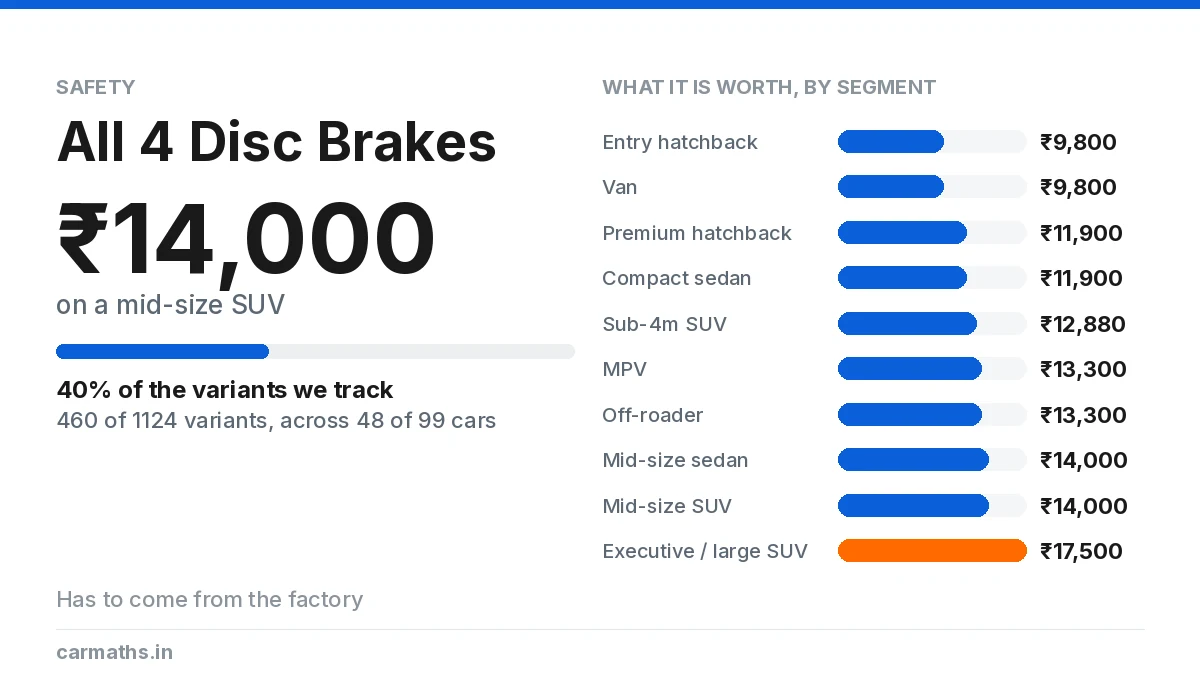
We value All 4 Disc Brakes at ₹14,000 on a mid-size SUV, and ₹9,800 to ₹17,500 depending on the segment. 458 of the 1122 variants we track carry them, across 48 of 99 models — the cheapest being the Mahindra XUV 3XO MX1 (Petrol manual) at ₹7,79,000.
*Ex-showroom, Delhi · Prices checked Oct 2026
What are all four disc brakes?
It means the car has disc brakes on the rear wheels as well as the front. Most cars sold in India pair front discs with rear drum brakes; a car with all four discs replaces those rear drums with discs and calipers.
Disc or drum: how each one works
A disc brake uses a caliper to squeeze two pads against a metal rotor that turns with the wheel. A drum brake presses curved shoes outward against the inside of a drum that turns with the wheel.
When you brake hard, the car's weight shifts forward, so the front brakes do most of the work. That is why manufacturers fit discs at the front first and often keep cheaper, more compact drums at the rear.
What rear discs change, and what they do not
Discs shed heat better than drums because the rotor is open to the air, so they are less prone to fading on repeated hard stops, such as a long descent in the ghats or a fast highway run. They also dry out sooner after water, and the pedal tends to feel more consistent from one stop to the next.
On a single stop from city speeds, the tyres and ABS decide the stopping distance far more than the rear brakes do. Do not read all four discs as a shorter stop in everyday driving; read it as brakes that hold up better when they are worked hard.
Why so many cars keep rear drums
The front brakes do most of the stopping, so a rear drum is rarely the limit in normal driving. Drums are cheaper, last a long time and make a simple handbrake easy to build in, which is why makers keep them on all but the dearer trims. Rear discs often arrive with an electronic parking brake, whose motors usually sit on the rear calipers.
Living with discs
Disc pads wear faster than drum shoes and are cheaper and quicker to change; a drum can go a very long way before it needs attention. Discs can squeal a little when cold or wet, and a rotor that has been worn too thin, or warped by heat, has to be replaced. Ask what the rear pads cost at a service before you decide they matter to you.
How common it is, by fuel
Share of the variants we track that carry All 4 Disc Brakes.
- Strong hybrid 86% (20 of 23)
- Electric 77% (80 of 103)
- Diesel 63% (142 of 225)
- Petrol 31% (207 of 659)
- CNG 8% (9 of 112)
Of the 283 variants we track with Electronic Parking Brake with Auto Hold, 271 also have All 4 Disc Brakes. Most electronic parking brakes work through motors on the rear calipers, so the two usually arrive together.
Where it depends on the version, not just the trim
On these cars, a trim carries it with one gearbox, fuel or battery and not another.
- Hyundai Venue · HX8
- Honda Elevate · V, VX, ZX, ZX+
- Hyundai Verna · HX8
- Mahindra Thar Roxx · MX3, MX5
- Skoda Kushaq · Sportline, Prestige, Monte Carlo
- Tata Nexon EV · Fearless
- Renault Duster · Evolution, Adventure, Techno+, Iconic
- Kia Syros · HTK+, HTK+(O)
- Nissan Tekton · Acenta, N-Connecta
How we decide a variant has it
We credit it only where the manufacturer's own specification lists a disc at the rear. Ventilated front discs with drums at the back do not count, however the brochure words it. Where a manufacturer gives rear discs to some versions of a trim and not others, such as the automatic but not the manual, or one battery pack but not the other, only those versions get it.
What to check at the showroom
- Read the rear-brake row of the specification table: it says Disc or Drum. A line such as "Disc brakes" on its own usually describes the front.
- Look through the rear wheel. A disc shows a flat metal rotor with a caliper clamped over it; a drum is a closed metal bowl.
- Check the exact version you are buying, not only the trim name. On some cars the answer changes with the gearbox or the battery.
Written by Rupesh Kumar · explanation reviewed
Standard, extra, or left out
33 cars have disc brakes on all four wheels on every version. On 15 cars it comes only on some versions, so you pay to climb to it. 51 cars do not offer them on any version.
The valuation
₹14,000Disc brakes on the rear wheels as well as the front, in place of rear drums.
Why this number: Rear disc conversion kits exist but are rarely road-legal in India without homologation.
No purchasable equivalent — an estimate of worth, not of cost. Low confidence means the figure is our judgement, not a shop price — which is why the upgrades below show what manufacturers actually charge for it: that is the check on our number. This is what the feature is worth to a buyer who wants it — not what it costs a manufacturer to fit, which nobody outside the factory knows and which would not help you anyway. How we arrive at every figure.
What it is worth on each kind of car
The same feature is worth less on a cheaper car: the buyer is more price-sensitive and it is a larger share of what they are paying.
18 variant upgrades on this site add it
Every one of them bundles it with other equipment, so none of these price differences is the price of this feature on its own. The upgrades that change the least besides it are listed first — they are the ones that tell you most.
| The upgrade | It costs | We value this at | Also changes | Verdict |
|---|---|---|---|---|
| Harrier Adventure X → Adventure X+ Tata Motors · Petrol manual | ₹35,000 | ₹17,500 | 1 other item | Worth it |
| Harrier Adventure X → Adventure X+ Tata Motors · Diesel manual | ₹40,000 | ₹17,500 | 1 other item | Fair upgrade |
| Harrier Adventure X → Adventure X+ Tata Motors · Petrol automatic | ₹35,000 | ₹17,500 | 2 other items | Worth it |
| Harrier Adventure X → Adventure X+ Tata Motors · Diesel automatic | ₹45,000 | ₹17,500 | 2 other items | Worth it |
| Comet EV Excite → Exclusive MG Motor · Electric 17.3 kWh | ₹90,000 | ₹9,800 | 4 other items | Pricey |
| Thar Roxx MX5 → AX5L Mahindra · Diesel automatic | ₹76,000 | ₹13,300 | 6 other items | Worth it |
| Verna HX8 → HX10 Hyundai · Petrol CVT | ₹1,06,000 | ₹14,000 | 7 other items | Worth it |
| Bayon HX6 → HX8 Hyundai · Petrol manual | ₹1,53,000 | ₹14,000 | 8 other items | Fair upgrade |
| Venue HX6 → HX8 Hyundai · Petrol DCT | ₹82,400 | ₹12,880 | 9 other items | Worth it |
| Bayon HX6 → HX8 Hyundai · Petrol IVT | ₹1,57,100 | ₹14,000 | 9 other items | Fair upgrade |
| Tekton N-Connecta → Tekna Nissan · Petrol manual | ₹1,40,000 | ₹14,000 | 10 other items | Fair upgrade |
| Tekton N-Connecta → Tekna Nissan · Petrol manual | ₹1,70,000 | ₹14,000 | 10 other items | Fair upgrade |
Showing the 12 with the fewest other changes, of 18. Every upgrade is listed on its car's own page, linked in the table below.
The cheapest variant of each car that has it
The last column is what that variant costs over the car's own entry price. It is not the price of this feature — climbing to that trim buys everything else on the way up too. It is the honest answer to “what do I have to spend on this car to get one?”
| Car | Cheapest variant with it | Ex-showroom | Over the base trim | Variants |
|---|---|---|---|---|
| Mahindra XUV 3XO | MX1 Petrol manual | ₹7,79,000 | standard fit | 31 of 31 |
| MG Astor | Sprint Petrol manual | ₹9,79,100 | standard fit | 7 of 7 |
| MG Comet EV | Exclusive Electric 17.3 kWh | ₹9,89,800 | +₹2,00,000 | 1 of 3 |
| Maruti Victoris | LXi Petrol manual | ₹10,49,900 | standard fit | 21 of 21 |
| Maruti Grand Vitara | Sigma Petrol manual | ₹10,76,500 | standard fit | 18 of 18 |
| Hyundai Creta | E Petrol manual | ₹10,90,700 | standard fit | 21 of 21 |
| Kia Seltos | HTE Petrol manual | ₹11,24,900 | standard fit | 33 of 33 |
| Kia Carens Clavis | HTE Petrol manual | ₹11,38,900 | standard fit | 22 of 22 |
| Tata Sierra | Smart+ Petrol manual | ₹11,49,000 | standard fit | 36 of 36 |
| Kia Syros | HTK+ Petrol DCT | ₹11,95,900 | +₹3,54,000 | 8 of 17 |
| MG Hector | Style Petrol manual | ₹12,14,000 | standard fit | 7 of 7 |
| Hyundai Venue | HX8 Petrol DCT | ₹13,02,900 | +₹5,03,000 | 4 of 18 |
| Tata Safari | Smart Petrol manual | ₹13,39,990 | standard fit | 22 of 22 |
| Kia Syros EV | HTK Electric 42 kWh | ₹13,49,900 | standard fit | 7 of 7 |
| Mahindra Scorpio N | Z2 Petrol manual | ₹13,69,000 | standard fit | 27 of 27 |
| Honda Elevate | V Petrol CVT | ₹13,79,000 | +₹1,99,000 | 4 of 9 |
| Mahindra XUV 3XO EV | AX5 Electric 39.4 kWh | ₹13,88,999 | standard fit | 2 of 2 |
| Mahindra XUV 7XO | AX Petrol manual | ₹13,99,000 | standard fit | 20 of 20 |
| Tata Nexon EV | Creative Electric 45 kWh | ₹14,34,000 | +₹1,85,000 | 4 of 6 |
| Renault Duster | Evolution Petrol DCT | ₹14,49,000 | +₹4,00,000 | 7 of 14 |
| Hyundai Alcazar | Executive Petrol manual | ₹14,50,700 | standard fit | 10 of 10 |
| MG Windsor EV | Excite Electric 38 kWh | ₹14,84,800 | standard fit | 5 of 5 |
| Nissan Tekton | Acenta Petrol DCT | ₹14,99,000 | +₹4,50,000 | 7 of 12 |
| Hyundai Bayon | HX8 Petrol manual | ₹15,09,900 | +₹5,10,000 | 4 of 11 |
| Mahindra Thar Roxx | MX3 Petrol automatic | ₹15,39,000 | +₹2,87,000 | 14 of 21 |
| Maruti e Vitara | Delta Electric 49 kWh | ₹16,19,000 | standard fit | 3 of 3 |
| Skoda Kushaq | Sportline Petrol DSG | ₹16,99,000 | +₹6,30,000 | 3 of 12 |
| Tata Curvv EV | Accomplished X Electric 55 kWh | ₹17,19,000 | standard fit | 2 of 2 |
| Hyundai Verna | HX10 Petrol CVT | ₹17,21,200 | +₹6,22,000 | 3 of 12 |
| Tata Harrier | Adventure X+ Petrol manual | ₹17,59,990 | +₹4,60,000 | 16 of 26 |
| MG ZS EV | Executive Electric 50.3 kWh | ₹17,99,000 | standard fit | 4 of 4 |
| MG Hector Plus | Sharp Pro Petrol manual | ₹17,99,800 | standard fit | 2 of 2 |
| Hyundai Creta Electric | Executive Electric 42 kWh | ₹18,02,800 | standard fit | 8 of 8 |
| Kia Carens Clavis EV | HTK+ Electric 42 kWh | ₹18,03,900 | standard fit | 8 of 8 |
| Jeep Compass | Sport Diesel manual | ₹18,29,000 | standard fit | 9 of 9 |
| Tata Curvv | Accomplished X+ Petrol DCA | ₹18,49,990 | +₹8,50,000 | 2 of 15 |
| Tata Sierra EV | Pure Electric 63 kWh | ₹18,79,000 | standard fit | 8 of 8 |
| Volkswagen Taigun | GT Plus Chrome Petrol DSG | ₹19,16,900 | +₹8,17,000 | 2 of 11 |
| Mahindra BE 6 | One Electric 59 kWh | ₹19,45,000 | standard fit | 7 of 7 |
| MG Hector Tomahawk EV | Excite 7S Electric 69.2 kWh | ₹19,49,800 | standard fit | 3 of 3 |
| Toyota Innova Hycross | GX Petrol CVT | ₹19,53,000 | standard fit | 6 of 6 |
| Mahindra XEV 9S | One Above Electric 59 kWh | ₹20,65,000 | standard fit | 6 of 6 |
| Honda City | ZX+ e:HEV Strong Hybrid e-CVT Hybrid CVT | ₹21,35,800 | +₹9,35,900 | 1 of 8 |
| Tata Harrier EV | Adventure Electric 65 kWh | ₹21,79,000 | standard fit | 7 of 7 |
| Mahindra XEV 9e | Pack One Electric 59 kWh | ₹21,90,000 | standard fit | 5 of 5 |
| Maruti Invicto | Zeta+ Hybrid CVT | ₹25,02,400 | standard fit | 2 of 2 |
| Toyota Fortuner | 4x2 Petrol automatic | ₹35,11,000 | standard fit | 7 of 7 |
| MG Majestor | Savvy 4x2 Diesel automatic | ₹43,49,000 | standard fit | 2 of 2 |
Ex-showroom, Delhi. How we read each car's prices and equipment, and how often we re-check them: where the numbers come from.
Common questions
- What are all four disc brakes?
- It means the car has disc brakes on the rear wheels as well as the front. Most cars sold in India pair front discs with rear drum brakes; a car with all four discs replaces those rear drums with discs and calipers.
- Are rear disc brakes necessary?
- Not for everyday driving, where the front brakes, the tyres and ABS decide how quickly you stop. They earn their keep on long descents and repeated hard stops, where they resist fading better than drums.
- Disc or drum brakes: which is better?
- Discs cool better and recover faster after water, so they cope better with repeated hard braking. Drums are cheaper and last longer. At the front, discs are always the better choice; at the rear the difference is small for most drivers.
- Do all-four disc brakes stop the car sooner?
- Not on a single stop from city speeds; that depends mostly on the tyres and ABS. The gain shows on the tenth hard stop down a ghat road, when drums may have started to fade.
- Do rear disc brakes cost more to maintain?
- A little. Pads wear faster than drum shoes and need changing more often, though each change is quicker. Ask the service centre the price of a rear pad set for the car you are considering.
- What are disc brakes on all four wheels worth in a car?
- CarMaths values it at ₹14,000 on a mid-size SUV, scaling to ₹9,800 on the cheapest segment and ₹17,500 on the most expensive. Rear disc conversion kits exist but are rarely road-legal in India without homologation.
- Can disc brakes on all four wheels be added after you buy the car?
- No. They have to come from the factory, so the trim that has them is the only way to get them. That is why the figure is what the feature is worth to you rather than what it costs to fit.
- Which is the cheapest car with disc brakes on all four wheels?
- Of the 99 cars CarMaths tracks, the cheapest variant carrying it is the Mahindra XUV 3XO MX1 (Petrol manual) at ₹7,79,000 ex-showroom, which is its entry price.
- What does a variant upgrade that adds disc brakes on all four wheels cost?
- The typical step that adds it costs ₹1,40,000, across 18 such upgrades — but every one of those upgrades adds other equipment too, so that figure is the price of the whole gap, not of this feature.