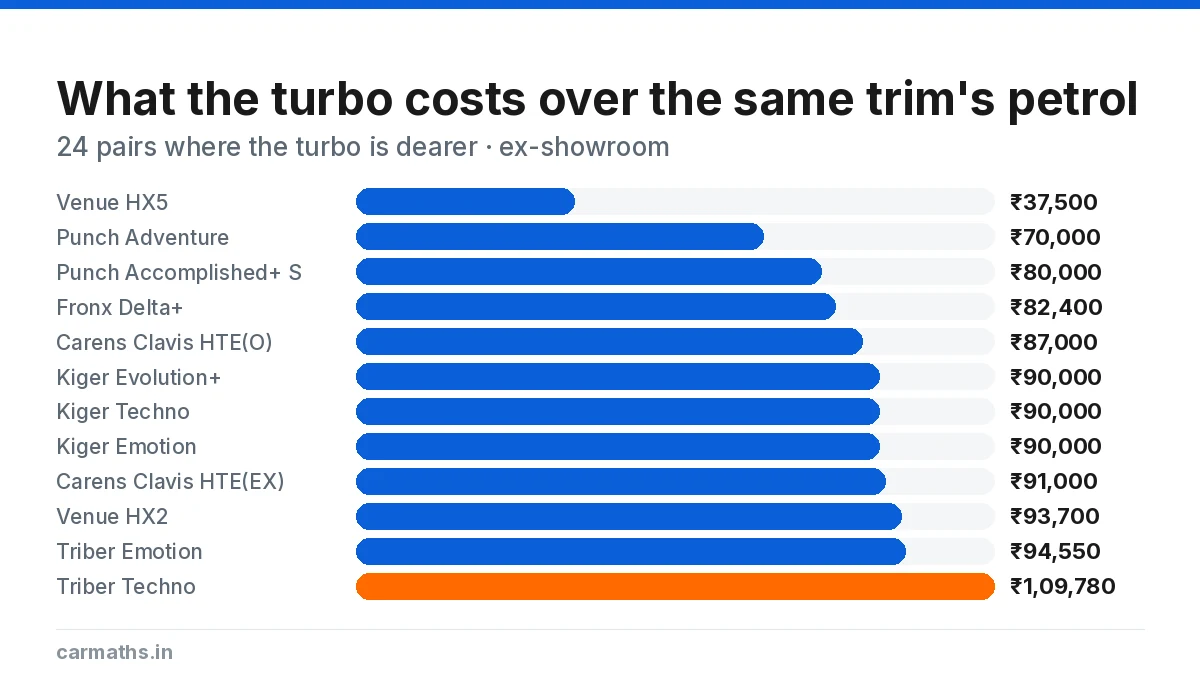
What does the turbo actually cost?
This is every case in our catalogue where a manufacturer sells the same trim, with the same gearbox, with a naturally aspirated petrol engine — the regular kind — and with a turbo petrol — 27 pairs across 12 cars. The difference between the two prices is what the turbo costs, plus any equipment the manufacturer changes alongside it, which is listed under each row rather than assumed away. Every one of the 27 is a manual: wherever a trim is sold on both engines as an automatic, it is a different kind of automatic on each, and that comparison would be part gearbox.
| Car and variant | Turbo costs | Extra power | Extra torque | Per extra bhp |
|---|---|---|---|---|
| Maruti Brezza LXi manual ₹8,34,900 → ₹7,49,900 The turbo version adds Automatic Climate Control, adds Height-Adjustable Driver's Seat, adds Rear Defogger. | −₹85,000 | +7 bhp+7% | +31 Nm+22% | — |
| Maruti Brezza VXi manual ₹9,30,900 → ₹8,64,900 The turbo version adds 16-Inch Alloy Wheels. | −₹66,000 | +7 bhp+7% | +31 Nm+22% | — |
| Maruti Brezza ZXi manual ₹10,54,900 → ₹9,94,900 The turbo version adds Rear Defogger & Wiper/Washer, adds Cruise Control, adds Automatic Headlamps, adds Blind Spot Monitor. | −₹60,000 | +7 bhp+7% | +31 Nm+22% | — |
| Hyundai Venue HX5 manual ₹9,55,600 → ₹9,93,100 The turbo version adds Cruise Control. | +₹37,500 | +36 bhp+44% | +57 Nm+50% | ₹1,042 |
| Tata Punch Adventure manual ₹7,76,990 → ₹8,46,990 The turbo version loses Multiple Drive Modes. | +₹70,000 | +31 bhp+36% | +55 Nm+48% | ₹2,258 |
| Tata Punch Accomplished+ S manual ₹9,16,990 → ₹9,96,990 The turbo version loses Multiple Drive Modes. | +₹80,000 | +31 bhp+36% | +55 Nm+48% | ₹2,581 |
| Maruti Fronx Delta+ manual ₹8,14,500 → ₹8,96,900 Nothing else we track changes. | +₹82,400 | +11 bhp+13% | +35 Nm+31% | ₹7,491 |
| Kia Carens Clavis HTE(O) manual ₹12,34,900 → ₹13,21,900 The turbo version loses Full Wheel Covers. | +₹87,000 | +45 bhp+40% | +109 Nm+76% | ₹1,933 |
| Renault Kiger Evolution+ manual ₹7,03,000 → ₹7,93,000 Nothing else we track changes. | +₹90,000 | +28 bhp+39% | +64 Nm+67% | ₹3,214 |
| Renault Kiger Techno manual ₹7,60,000 → ₹8,50,000 Nothing else we track changes. | +₹90,000 | +28 bhp+39% | +64 Nm+67% | ₹3,214 |
| Renault Kiger Emotion manual ₹8,50,000 → ₹9,40,000 Nothing else we track changes. | +₹90,000 | +28 bhp+39% | +64 Nm+67% | ₹3,214 |
| Kia Carens Clavis HTE(EX) manual ₹12,85,900 → ₹13,76,900 The turbo version loses Full Wheel Covers. | +₹91,000 | +45 bhp+40% | +109 Nm+76% | ₹2,022 |
| Hyundai Venue HX2 manual ₹7,99,900 → ₹8,93,600 Nothing else we track changes. | +₹93,700 | +36 bhp+44% | +57 Nm+50% | ₹2,603 |
| Renault Triber Emotion manual ₹8,05,350 → ₹8,99,900 Nothing else we track changes. | +₹94,550 | +28 bhp+39% | +84 Nm+88% | ₹3,377 |
| Renault Triber Techno manual ₹7,44,120 → ₹8,53,900 Nothing else we track changes. | +₹1,09,780 | +28 bhp+39% | +84 Nm+88% | ₹3,921 |
| Citroën C3X Shine manual ₹7,86,000 → ₹8,97,000 The turbo version adds Electronic Stability Control (ESC), adds 15-Inch Alloy Wheels. | +₹1,11,000 | +27 bhp+33% | +75 Nm+65% | ₹4,111 |
| Renault Triber Evolution manual ₹6,73,605 → ₹7,84,900 Nothing else we track changes. | +₹1,11,295 | +28 bhp+39% | +84 Nm+88% | ₹3,975 |
| Nissan Magnite Tekna manual ₹8,43,000 → ₹9,61,000 Nothing else we track changes. | +₹1,18,000 | +28 bhp+39% | +64 Nm+67% | ₹4,214 |
| Nissan Magnite Tekna+ manual ₹8,76,000 → ₹9,95,000 Nothing else we track changes. | +₹1,19,000 | +28 bhp+39% | +64 Nm+67% | ₹4,250 |
| Citroën Basalt X Max manual ₹11,34,300 → ₹12,62,500 Nothing else we track changes. | +₹1,28,200 | +27 bhp+33% | +75 Nm+65% | ₹4,748 |
| Nissan Magnite N-Connecta manual ₹7,50,000 → ₹8,81,000 Nothing else we track changes. | +₹1,31,000 | +28 bhp+39% | +64 Nm+67% | ₹4,679 |
| Citroën Aircross X Max manual ₹11,62,000 → ₹12,97,000 The turbo version adds 17-Inch Alloy Wheels. | +₹1,35,000 | +27 bhp+33% | +75 Nm+65% | ₹5,000 |
| Hyundai Verna HX8 manual ₹14,94,200 → ₹16,34,200 The turbo version adds Multiple Drive Modes, adds Integrated Dashcam, adds Blind Spot Monitor. | +₹1,40,000 | +45 bhp+40% | +109 Nm+76% | ₹3,111 |
| Citroën Basalt X You manual ₹8,55,000 → ₹9,99,000 Nothing else we track changes. | +₹1,44,000 | +27 bhp+33% | +75 Nm+65% | ₹5,333 |
| Citroën C3X Feel manual ₹5,99,900 → ₹7,57,900 The turbo version adds Electronic Stability Control (ESC), adds 7-Inch Digital Instrument Cluster. | +₹1,58,000 | +27 bhp+33% | +75 Nm+65% | ₹5,852 |
| Citroën Basalt X Plus manual ₹9,99,000 → ₹11,57,000 The turbo version adds LED Fog Lamps. | +₹1,58,000 | +27 bhp+33% | +75 Nm+65% | ₹5,852 |
| Citroën Aircross X Plus manual ₹9,99,000 → ₹11,99,000 The turbo version adds Automatic Climate Control, adds Rear AC Vents, adds 60:40 Split Rear Seat, adds LED Projector Headlamps, adds Front Centre Armrest with Storage. | +₹2,00,000 | +27 bhp+33% | +75 Nm+65% | ₹7,407 |
Ex-showroom, Delhi. Power and torque are the manufacturer's own figures for each engine. “Per extra bhp” is the price gap divided by the power gained, shown only where the turbo costs more.
What the numbers say
Where the turbo costs more — 24 of the 27 pairs — the typical gap is ₹1,10,390, for 39% more power and 66% more torque: about ₹3,948 for every extra bhp. The other 3 are left out of that median because there the turbo is the cheaper car — a negative "premium" would pull the typical figure down for a reason that has nothing to do with what a turbo costs; they have a section of their own below. Torque rises by more than power in the typical case, which is what a turbo is for: more pull from low revs, the part you feel when overtaking.
The least a turbo adds is ₹37,500, on the Hyundai Venue HX5, for 36 more bhp. The most is ₹2,00,000, on the Citroën Aircross X Plus, for 27 more bhp. “Typical” is the median of the cases we hold, not an average of advertised prices.
When the turbo is the cheaper car
On 3 of the 27 pairs the turbo version costs less — every one of them on the Maruti Brezza. There the turbo is also the smaller engine — 998 cc against 1,462 cc, and the non-turbo engine is a mild hybrid — so the comparison is not a turbo bolted onto the same motor but two different engines that happen to share the trim names. The table lists what else changes between them, from the manufacturer's own brochure, and on every one of these pairs the turbo version also carries more of the equipment we track, not less. Read those rows as two different cars sold under one set of trim names.
Turbo or regular petrol: the trade-off in our figures
- Power and pull. In the typical case the turbo adds 39% more power and 66% more torque on the same trim and gearbox.
- Price. It costs ₹1,10,390 more in the typical case, and less on 3 pairs where the two are different engines.
- Fuel. Of the 13 pairs with a certified figure for both engines, the turbo is rated thirstier on 1 and more frugal on 10, and the two are rated the same on 2.
So the turbo is the one to pay for if you want the extra pull — highway overtaking, a full car, hills — and the regular engine is the one to keep if the car mostly does short city trips where that pull is rarely used. That is the trade-off; which side of it you are on is yours to judge.
Why we do not give this a value verdict
Everywhere else on this site we price the equipment difference between two variants and say what share of the price rise it explains. An engine is not equipment, so we refuse to score a change of engine for exactly the reason we refuse to score a change of gearbox — see what an automatic actually costs. The honest answer is the one above: here is what the turbo costs and what it gives you, and whether the extra pull is worth that to you is your call. Our verdicts stay for comparisons where equipment really is the difference.
Does the turbo use more fuel?
We can only answer where the manufacturer publishes a certified figure for both engines, which is 13 of the 27 pairs. Maruti Fronx Delta+: 21.79 kmpl naturally aspirated against 21.5 kmpl turbo. Kia Carens Clavis HTE(O) and HTE(EX): 15.34 kmpl naturally aspirated against 15.95 kmpl turbo. Nissan Magnite N-Connecta and Tekna and Tekna+: 19.4 kmpl naturally aspirated against 19.9 kmpl turbo. Citroën C3X Feel and Shine: 19.3 kmpl naturally aspirated against 19.3 kmpl turbo. Citroën Basalt X You and Plus and Max: 18 kmpl naturally aspirated against 19.5 kmpl turbo. Citroën Aircross X Plus and Max: 17.5 kmpl naturally aspirated against 18.5 kmpl turbo. So the turbo is not always the thirstier engine on paper — it goes both ways in our data.
For the other 14 pairs, at least one of the two engines has no certified figure published, and we do not lend one engine another's number. Certified figures are measured on a fixed test cycle, not on your commute.
Where we could not measure it
4 cars sell the same trim with both engines but never with the same gearbox on each, so the price gap would be part gearbox and is left out: the Kia Seltos, the Hyundai Creta, the Kia Sonet and the Tata Sierra.
1 car offers both engines but on different trims, so no single trim can be held still: the Toyota Urban Cruiser Taisor.
And 20 of the 98 cars we track sell only a turbo petrol, so there is no naturally aspirated version to compare against. Every engine and gearbox each car above is sold with is set out variant by variant on its powertrains page: Maruti Brezza, Hyundai Venue, Tata Punch, Maruti Fronx, Kia Carens Clavis, Renault Kiger, Renault Triber, Citroën C3X, Nissan Magnite, Citroën Basalt X, Citroën Aircross X and Hyundai Verna.