Cars With Dual-Pane Panoramic Sunroof in India
We value Dual-Pane Panoramic Sunroof at ₹55,000 on a mid-size SUV, and ₹38,500 to ₹68,750 depending on the segment. 337 of the 1122 variants we track carry it, across 43 of 99 models — the cheapest being the Tata Nexon Pure+ PS (Petrol manual) at ₹9,71,990.
*Ex-showroom, Delhi · Prices checked Oct 2026
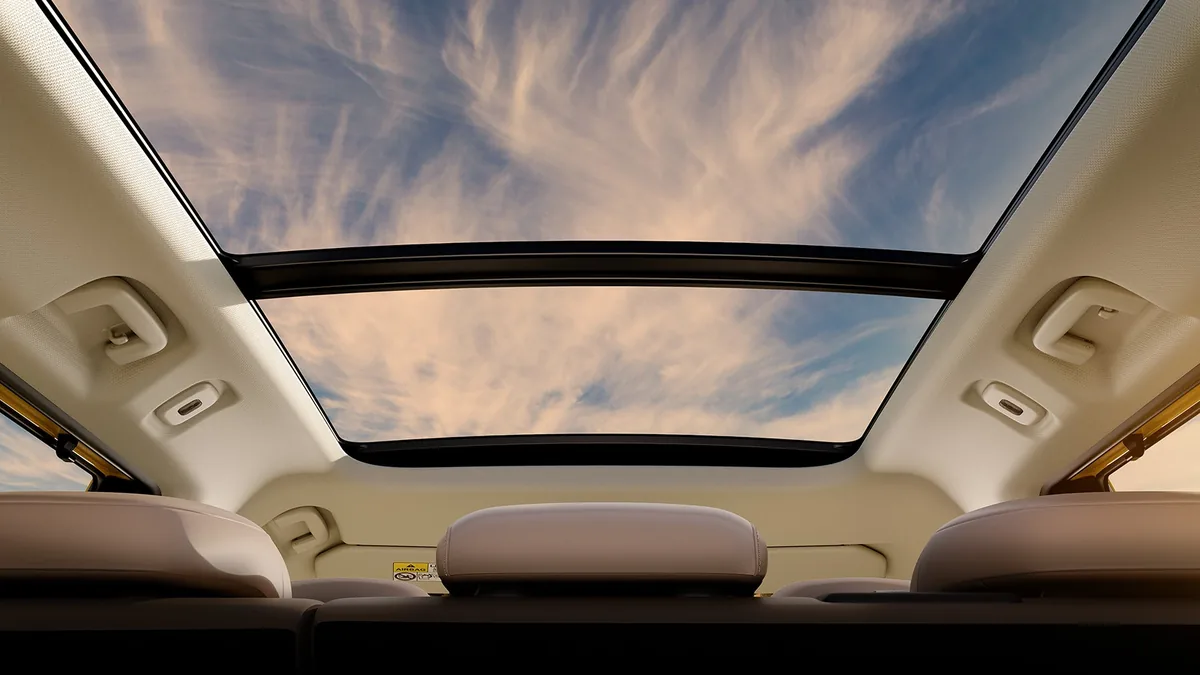
What is a panoramic sunroof?
A panoramic sunroof is a large glass roof that stretches over both the front and the rear seats, usually in two panels. The front panel opens like an ordinary sunroof; the rear one is fixed and lets light into the back.
How it differs from a single sunroof
A single sunroof covers only the front seats. A panoramic roof extends the glass over most of the roof, so rear passengers see the sky too and the cabin feels brighter and larger. It also puts more glass over your head, which is why a good sunblind matters even more.
Living with one
On a hot afternoon a big glass roof lets heat into the cabin even with the AC running, so expect to keep the blind closed for much of the day. Open, it brings wind noise at highway speeds, and the drains around the front panel need to stay clear, as with any opening roof.
Panoramic or single-pane: what you gain
On most twin-panel roofs the front panel slides back over the fixed rear one, so the opening is not much bigger than a single sunroof's. What grows is the glass, not the gap: the people in the back get light and a view of the sky, and the whole cabin feels more open.
So the case for a panoramic roof rests on who sits in the back. For a driver who usually travels alone or with one passenger, a single sunroof opens almost as wide for less money.
Big glass roofs we do not count
Some cars have a large glass roof that does not open at all. Mahindra's Infinity Roof on the BE 6 and XEV 9e is one example: a fixed sheet of glass over the whole cabin. It brings light in, but you cannot open it for air, so it earns nothing here, however large it is. A car with fixed glass is therefore not among the cars listed on this page, which can look surprising until you read the brochure's wording.
The glass and the sunblind
Makers treat the glass differently. Some use a tinted or coated glass to cut heat and glare; the brochure usually says so when they do. The sunblind matters as much as the glass: an electric blind that covers both panels in one sweep is easier to live with than one you pull by hand, and a thin mesh blind lets more heat through than a solid one.
How common it is, by fuel
Share of the variants we track that carry Dual-Pane Panoramic Sunroof.
- Strong hybrid 52% (12 of 23)
- Electric 48% (50 of 103)
- Diesel 47% (106 of 225)
- Petrol 24% (164 of 659)
- CNG 4% (5 of 112)
Where it depends on the version, not just the trim
On these cars, a trim carries it with one gearbox, fuel or battery and not another.
How we decide a variant has it
We credit it only for a panoramic roof whose front section opens. A fixed panoramic glass roof that does not open earns nothing, however large. This is the higher of two sunroof levels: a variant with it is not also credited the single-panel sunroof, and moving up from one to the other counts as one change.
What to check at the showroom
- Open the front panel and see how far it slides back.
- Look at the blind from the rear seat: does it cover all of the glass, and is it electric?
- If you can, sit in the back on a sunny day and feel how much heat comes through with the blind open.
Written by Rupesh Kumar · explanation reviewed
Standard, extra, or left out
5 cars have a panoramic sunroof on every version. On 38 cars it comes only on some versions, so you pay to climb to it. 56 cars do not offer it on any version.
The valuation
₹55,000Full-length dual-pane panoramic glass roof whose front panel opens.
Why this number: Cutting a roof aperture afterwards compromises structural rigidity. The most-requested feature in this segment, which is why it carries the highest comfort value here.
No purchasable equivalent — an estimate of worth, not of cost. Low confidence means the figure is our judgement, not a shop price — which is why the upgrades below show what manufacturers actually charge for it: that is the check on our number. This is what the feature is worth to a buyer who wants it — not what it costs a manufacturer to fit, which nobody outside the factory knows and which would not help you anyway. How we arrive at every figure.
What it is worth on each kind of car
The same feature is worth less on a cheaper car: the buyer is more price-sensitive and it is a larger share of what they are paying.
What the level below and above are worth
A variant carries one of these, not several, so moving between them is a single upgrade worth the difference — not a feature gained and another lost. That is why a trim that swaps a single-pane electric sunroof for a panoramic sunroof is credited with the gap between them, and why the page it appears on does not claim it lost anything.
- Single-Pane Electric SunroofFrom the Hyundai i20 Magna, ₹7,04,900₹35,000
- Dual-Pane Panoramic SunroofFrom the Tata Nexon Pure+ PS, ₹9,71,990₹55,000 +₹20,000 on the level below
149 variant upgrades on this site add it
On 14 of them it is the only equipment that changes, which makes those upgrades the closest thing to a manufacturer's own price for it — typically ₹9,100. The rest bundle it with other kit, so the price difference covers more than this one item. Steps with the fewest other changes are listed first.
| The upgrade | It costs | We value this at | Also changes | Verdict |
|---|---|---|---|---|
| Grand Vitara Alpha → Alpha(O) Maruti Suzuki · Petrol manual | ₹4,000 | ₹55,000 | nothing else | Worth it |
| Grand Vitara Alpha → Alpha(O) Maruti Suzuki · Petrol automatic | ₹4,000 | ₹55,000 | nothing else | Worth it |
| Grand Vitara Zeta → Zeta(O) Maruti Suzuki · Petrol manual | ₹4,100 | ₹55,000 | nothing else | Worth it |
| Grand Vitara Zeta → Zeta(O) Maruti Suzuki · Petrol automatic | ₹4,100 | ₹55,000 | nothing else | Worth it |
| Grand Vitara Alpha+ → Alpha+(O) Maruti Suzuki · Hybrid CVT | ₹6,800 | ₹55,000 | nothing else | Worth it |
| Victoris ZXi → ZXi(O) Maruti Suzuki · Petrol manual | ₹7,100 | ₹55,000 | nothing else | Worth it |
| Victoris ZXi → ZXi(O) Maruti Suzuki · Petrol automatic | ₹7,100 | ₹55,000 | nothing else | Worth it |
| Victoris ZXi+ → ZXi+(O) Maruti Suzuki · Petrol manual | ₹9,100 | ₹55,000 | nothing else | Worth it |
| Victoris ZXi+ → ZXi+(O) Maruti Suzuki · Petrol automatic | ₹9,100 | ₹55,000 | nothing else | Worth it |
| Victoris ZXi+ → ZXi+(O) Maruti Suzuki · Hybrid CVT | ₹47,000 | ₹55,000 | nothing else | Worth it |
| Grand Vitara Alpha ALLGRIP → Alpha(O) ALLGRIP Maruti Suzuki · Petrol automatic 4WD | ₹57,900 | ₹55,000 | nothing else | Fair upgrade |
| Victoris ZXi+ → ZXi+(O) Maruti Suzuki · Petrol automatic 4WD | ₹58,000 | ₹55,000 | nothing else | Fair upgrade |
Showing the 12 with the fewest other changes, of 149. Every upgrade is listed on its car's own page, linked in the table below.
The cheapest variant of each car that has it
The last column is what that variant costs over the car's own entry price. It is not the price of this feature — climbing to that trim buys everything else on the way up too. It is the honest answer to “what do I have to spend on this car to get one?”
| Car | Cheapest variant with it | Ex-showroom | Over the base trim | Variants |
|---|---|---|---|---|
| Tata Nexon | Pure+ PS Petrol manual | ₹9,71,990 | +₹2,32,000 | 15 of 44 |
| Mahindra XUV 3XO | REVX EDGE (O) Petrol manual | ₹9,89,000 | +₹2,10,000 | 15 of 31 |
| Kia Syros | HTK+ Petrol manual | ₹10,75,900 | +₹2,34,000 | 12 of 17 |
| MG Astor | Shine Petrol manual | ₹11,34,100 | +₹1,55,000 | 6 of 7 |
| Tata Curvv | Creative X+ Petrol manual | ₹12,90,990 | +₹2,91,000 | 8 of 15 |
| Renault Duster | Adventure Petrol manual | ₹12,99,000 | +₹2,50,000 | 9 of 14 |
| Hyundai Creta | EX(O) Petrol manual | ₹13,14,200 | +₹2,23,500 | 17 of 21 |
| Hyundai Bayon | HX6 Petrol manual | ₹13,56,900 | +₹3,57,000 | 6 of 11 |
| Maruti Victoris | ZXi(O) Petrol manual | ₹13,69,000 | +₹3,19,100 | 7 of 21 |
| Nissan Tekton | N-Connecta Petrol manual | ₹13,69,000 | +₹3,20,000 | 8 of 12 |
| Maruti Grand Vitara | Zeta(O) Petrol manual | ₹13,89,100 | +₹3,12,600 | 7 of 18 |
| Tata Sierra | Pure L (O) Petrol manual | ₹14,29,000 | +₹2,80,000 | 25 of 36 |
| Kia Seltos | HTK(O) Petrol manual | ₹14,51,900 | +₹3,27,000 | 23 of 33 |
| Toyota Urban Cruiser Hyryder | G(O) Petrol manual | ₹14,87,000 | +₹3,56,000 | 6 of 12 |
| MG Hector | Select Pro Petrol manual | ₹14,94,800 | +₹2,80,800 | 6 of 7 |
| Mahindra XUV 3XO EV | AX7L Electric 39.4 kWh | ₹14,95,999 | +₹1,07,000 | 1 of 2 |
| Kia Syros EV | HTX Electric 42 kWh | ₹15,99,900 | +₹2,50,000 | 4 of 7 |
| Volkswagen Taigun | Topline Petrol manual | ₹16,21,900 | +₹5,22,000 | 4 of 11 |
| Tata Harrier | Pure X Petrol manual | ₹16,39,990 | +₹3,40,000 | 24 of 26 |
| Kia Carens Clavis | HTK+(O) Petrol manual | ₹16,41,900 | +₹5,03,000 | 8 of 22 |
| Hyundai Alcazar | Prestige Petrol manual | ₹16,81,300 | +₹2,30,600 | 6 of 10 |
| Tata Safari | Pure X Petrol manual | ₹16,84,990 | +₹3,45,000 | 20 of 22 |
| Skoda Kushaq | Prestige Petrol manual | ₹16,94,000 | +₹6,25,000 | 5 of 12 |
| Tata Curvv EV | Accomplished X Electric 55 kWh | ₹17,19,000 | standard fit | 2 of 2 |
| Tata Nexon EV | Empowered+ A Electric 45 kWh | ₹17,69,000 | +₹5,20,000 | 1 of 6 |
| Mahindra XUV 7XO | AX5 Petrol manual | ₹17,88,000 | +₹3,89,000 | 14 of 20 |
| Mahindra Thar Roxx | Star Edition Diesel manual | ₹17,97,000 | +₹5,45,000 | 8 of 21 |
| MG Hector Plus | Sharp Pro Petrol manual | ₹17,99,800 | standard fit | 2 of 2 |
| MG ZS EV | Excite Pro Electric 50.3 kWh | ₹18,74,600 | +₹75,600 | 3 of 4 |
| Hyundai Creta Electric | Executive Tech Electric 42 kWh | ₹18,99,900 | +₹97,100 | 7 of 8 |
| Tata Sierra EV | Pure S Electric 63 kWh | ₹19,99,000 | +₹1,20,000 | 7 of 8 |
| Kia Carens Clavis EV | HTX E Electric 42 kWh | ₹19,99,900 | +₹1,96,000 | 7 of 8 |
| Mahindra XEV 9S | One Above Electric 59 kWh | ₹20,65,000 | standard fit | 6 of 6 |
| Mahindra Scorpio N | Z8L Petrol manual | ₹21,31,387 | +₹7,62,387 | 6 of 27 |
| MG Hector Tomahawk EV | Exclusive 7S Electric 69.2 kWh | ₹21,99,800 | +₹2,50,000 | 2 of 3 |
| Tata Harrier EV | Adventure S Electric 65 kWh | ₹22,29,000 | +₹50,000 | 6 of 7 |
| Jeep Compass | Longitude (O2) Diesel manual | ₹23,63,000 | +₹5,34,000 | 7 of 9 |
| BYD Atto 3 | Dynamic Electric 49.92 kWh | ₹24,99,000 | standard fit | 3 of 3 |
| Jeep Meridian | Longitude Plus Diesel manual | ₹26,30,000 | +₹2,97,000 | 7 of 9 |
| Maruti Invicto | Alpha+ Hybrid CVT | ₹28,70,500 | +₹3,68,100 | 1 of 2 |
| Toyota Innova Hycross | VX(O) Hybrid CVT | ₹28,77,000 | +₹9,24,000 | 3 of 6 |
| BYD eMax 7 | Superior Electric 71.8 kWh | ₹29,90,000 | +₹1,60,000 | 1 of 2 |
| MG Majestor | Savvy 4x2 Diesel automatic | ₹43,49,000 | standard fit | 2 of 2 |
Ex-showroom, Delhi. How we read each car's prices and equipment, and how often we re-check them: where the numbers come from.
Common questions
- What is a panoramic sunroof?
- A panoramic sunroof is a large glass roof that stretches over both the front and the rear seats, usually in two panels. The front panel opens like an ordinary sunroof; the rear one is fixed and lets light into the back.
- Is a panoramic sunroof worth it over a normal sunroof?
- It depends on who sits in the back. The opening on most panoramic roofs is close to a single sunroof's, so the driver gains little. Rear passengers gain light and a view of the sky. If the back seat is often used, by children for example, the bigger glass makes the most difference there.
- Does a panoramic sunroof make the car hot?
- It can. More glass over your head lets in more heat in the afternoon sun, even with the AC running. Keep the sunblind closed on hot days, and check on a test drive how well the blind blocks the heat.
- Does a panoramic sunroof leak?
- A roof in good order should not. When water does get in, the usual cause is a blocked drain tube at one of the corners of the opening, which carries rainwater away. Keeping those drains clear of dust and leaves, and checking them at a service, prevents most leaks.
- Can you open the rear panel of a panoramic sunroof?
- Usually not. On most cars only the front panel opens, tilting up or sliding back over the rear one. The rear panel is fixed glass that lets light into the back.
- Is a panoramic sunroof safe in a crash?
- The roof glass is safety glass, and the frame around it is part of the body the car was designed and crash-tested with. A crash-test rating, where the car has one, is a better guide to how the car protects you than the roof itself.
- What is a panoramic sunroof worth in a car?
- CarMaths values it at ₹55,000 on a mid-size SUV, scaling to ₹38,500 on the cheapest segment and ₹68,750 on the most expensive. Cutting a roof aperture afterwards compromises structural rigidity. The most-requested feature in this segment, which is why it carries the highest comfort value here.
- Can a panoramic sunroof be added after you buy the car?
- No. It has to come from the factory, so the trim that has it is the only way to get it. That is why the figure is what the feature is worth to you rather than what it costs to fit.
- Which is the cheapest car with a panoramic sunroof?
- Of the 99 cars CarMaths tracks, the cheapest variant carrying it is the Tata Nexon Pure+ PS (Petrol manual) at ₹9,71,990 ex-showroom, which is ₹2,32,000 above that car's entry price.
- What does a variant upgrade that adds a panoramic sunroof cost?
- Across the 14 variant upgrades on this site where it is the only equipment that changes, the typical price difference is ₹9,100. That is the closest thing to a manufacturer's own price for it.
For the cheapest variant of every car with a sunroof, single-pane and panoramic together, see Cars With a Sunroof in India — Cheapest Variant of Each.